

Key Takeaways
- Humility – not fame – was the turning point that pushed Shaquille O’Neal toward financial education.
- He invests only in businesses he understands and personally uses.
- Formal education and real-world mentorship shaped his credibility in boardrooms.
- Franchising became his foundation because of its predictable systems and real-world value.
- His empire is built on discipline, not celebrity – proof that learning is the greatest multiplier.
The Realization that Money Wasn’t the Same as Wealth
Shaquille O’Neal – a.k.a. Shaq – entered the NBA with talent, charisma, and a contract that made him one of the highest-paid rookies in basketball. And within 30 minutes of receiving his first million-dollar payment, he had spent almost all of it – a cautionary moment he has openly referenced for years. It was the first time he understood how quickly money disappears when you don’t understand how to manage it.
Not long after, he experienced another defining moment. Shaq walked into a luxury car dealership, prepared to make a purchase, and watched as the salesperson ignored him and spoke instead to the security personnel accompanying him. Shaq has recalled this moment publicly as the one that made something click: having money doesn’t guarantee respect – knowledge does.
That realization didn’t bruise his ego. It sharpened his focus. If he wanted to be taken seriously in business, he needed to understand business. And that’s where his next chapter began – not as Shaq the superstar, but as Shaq the student.
Shaquille O’Neal: From Rookie Spending Sprees to Relentless Discipline
Learning the Hard Way
Shaquille O’Neal’s first major financial wake-up call came early in his NBA career, when he quickly spent a substantial portion of his first million-dollar paycheck on cars, jewelry, and gifts for family and friends. His banker sat him down and made it clear that the spending pace was unsustainable, even for a rising star with a large contract.
Shaq has retold this moment for decades as the first time he understood that income isn’t the same as wealth. The shock wasn’t just about the money that disappeared – it was about realizing how little he knew about budgeting, investing, or building long-term security.
That conversation shifted his mindset overnight from “earning money” to learning money.
Treating Business Like a Second Career
What distinguishes Shaq from many athletes of his generation is that he refused to outsource his financial life entirely to agents and advisors. Early on, he decided that business would be his second full-time career, not a side activity.
He began immersing himself in the business world with the same intensity he once applied to basketball:
- He sought out experts – franchise operators, small-business owners, CEOs, and entrepreneurs – wanting to understand how their companies actually worked.
- He asked thousands of questions, drilling into margins, customer behavior, operational models, and risk.
- He shadowed operators, visiting stores, distribution centers, and offices to understand what made a business succeed on a systems level.
- He studied failure, analyzing why certain franchises or brands collapsed and how poor decisions ripple across a company.
Through this process, Shaq refined the investment philosophy that has guided him ever since: If he didn’t understand the business, he wouldn’t invest. And if he didn’t personally use the product, he wouldn’t endorse it.
This practical, grounded approach became his filter for separating hype from real value.
Formalizing His Education
For Shaq, business education wasn’t symbolic – it was strategic. While still playing in the NBA, he enrolled in the University of Phoenix to earn his MBA, often taking late-night classes around his travel schedule. He later pushed his academic goals even further by earning a doctorate in education from Barry University, completing a dissertation focused on leadership and organizational growth.
His reasoning has been consistent and public: he wanted to walk into boardrooms with earned expertise, not celebrity privilege. He believed that understanding finance, management, and organizational behavior would help him engage with executives and investors as a peer – not just a famous spokesperson.
This combination of academic learning and practical immersion made him unusually well-prepared for life after basketball.
From Celebrity Deals to Real Ownership
As Shaq’s understanding deepened, his business strategy evolved dramatically. Early in his career, many opportunities came in the form of traditional endorsement deals – appearances, commercials, licensing. But as he grew more knowledgeable, he shifted toward roles with equity, governance, and operational involvement.
He pursued:
- Large-scale franchise ownership, taking stakes in Krispy Kreme, Papa John’s, and previously Five Guys.
- Tech investments, including an early position in Ring prior to its acquisition by Amazon.
- Brand ownership, becoming a major investor and board member at Authentic Brands Group.
- Long-term partnerships, where he worked closely with companies he actually used, from printers to snacks to insurance.
This wasn’t an image play – it was the natural outcome of a decade of disciplined decision-making. Shaq built an empire by treating business the same way he treated basketball: with preparation, humility, and a willingness to keep learning.
A Business Portfolio Built on Ownership, Discipline, and Personal Belief
Shaquille O’Neal’s business empire spans franchises, technology, consumer brands, media, and corporate governance. But what sets his portfolio apart from the usual celebrity playbook is the rigor behind it: Shaq only invests in companies he uses, understands, and trusts – guided by lessons he’s absorbed from founders and operators, not from celebrity advisers.
Franchise Foundations: Learning Through Real Ownership
Shaq’s earliest and most consistent business moves came through franchising – not as a spokesperson, but as a hands-on owner. Over the years, he has owned dozens of franchise locations across multiple brands:
- Krispy Kreme – Shaq remains one of the brand’s most notable franchise owners and serves as a major ambassador.
- Five Guys – At one point, Shaq owned numerous Five Guys locations before exiting the network.
- Papa John’s – Shaq has held an equity stake, served on the board, and played a key role in the chain’s reputational turnaround.
His attraction to franchising is simple: proven models, predictable operations, and products everyday people already understand.
Equity Plays and Corporate Influence
Beyond storefronts, Shaq has built a strong record in equity-based business roles – positions where he contributes to strategy, not just marketing.
- Authentic Brands Group (ABG) – Significant shareholder and board member at the global brand powerhouse behind Reebok, Forever 21, and Sports Illustrated.
- Ring – One of Shaq’s most successful early tech investments, made prior to the company’s billion-dollar acquisition by Amazon.
Across all partnerships – Google, Lyft, and others – his rule remains: If he doesn’t use it, he doesn’t buy it.
Media and Cultural Presence as an Engine, Not a Distraction
Between Inside the NBA, his DJ career, and his enormous social influence, Shaq’s media presence forms a self-sustaining ecosystem. But unlike typical celebrity brands, the media persona doesn’t drive the business strategy – it amplifies it. Visibility brings deal flow, but discipline filters the opportunities.
The Through-Line: Curiosity Over Celebrity
Shaq still describes himself in humble terms: a student of business, not a master of it. He credits curiosity, mentorship, and continuous learning – not fame – as the reason his portfolio keeps expanding in both scale and sophistication.
His evolution is clear: he stopped renting his reputation and started buying into the companies he believes can shape the future.
Wealth Begins When Ego Ends
Shaquille O’Neal’s entrepreneurial journey isn’t a story of celebrity advantage. It’s a story of self-awareness and discipline.
He made mistakes early. He admitted them. And rather than hide them, he used them to build a foundation of financial literacy, operational knowledge, and thoughtful investment.
The real lesson? Wealth compounds when curiosity replaces ego – and when learning becomes a lifelong habit.
FAQs
1. What was Shaquille O’Neal’s first major business lesson?
Overspending his first million quickly taught him the difference between income and true financial management.
2. What industries has Shaq invested in?
He has invested in franchises, technology, media, consumer products, and brand ownership.
3. Does Shaq have formal business education?
Yes – he earned an MBA and later completed a doctorate in education.
4. What is Shaq’s investment philosophy?
He invests only in companies he understands and products he personally uses.
5. What companies is Shaq most publicly associated with?
Krispy Kreme, Papa John’s, Authentic Brands Group, and the formerly owned Five Guys franchises.
Sources:
- https://en.wikipedia.org/wiki/Shaquille_O%27Neal
- https://finance.yahoo.com/news/shaq-once-spent-1m-one-111500794.html
- https://www.instagram.com/reel/DKcg9r-gCc4/
- https://www.tiktok.com/@grahambensinger/video/7193464043057745195
- https://www.cnbc.com/2020/10/26/shaquille-oneal-says-magic-johnson-gave-him-this-money-advice.html
- https://www.businessinsider.com/shaq-net-worth-jeff-bezos-investment-strategy-2019-7
- https://finance.yahoo.com/news/shaq-refused-spend-80-000-000221288.html
- https://my.barry.edu/news/article.html?id=21082
- https://arthnova.com/shaq-franchise-empire-five-guys-gyms-restaurants/
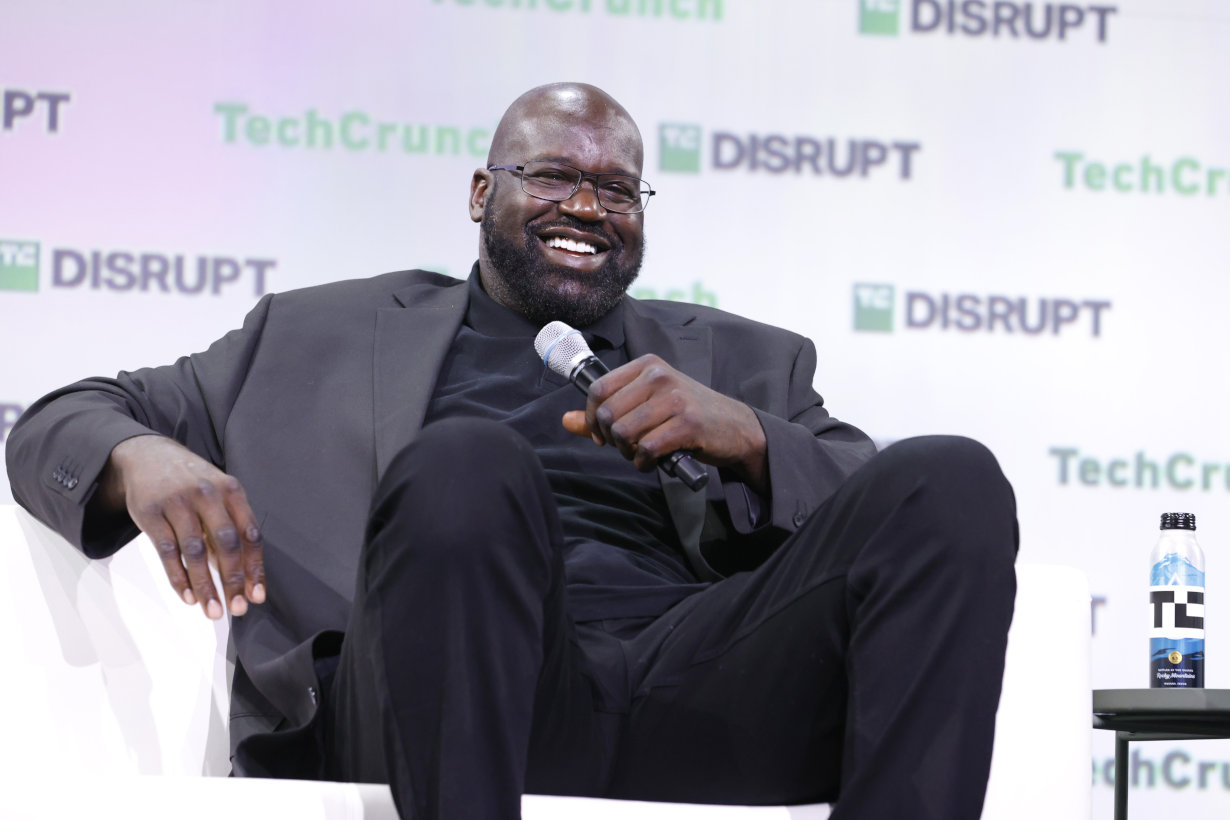
Photo credit: TechCrunch / Wikimedia Commons / CC BY 2.0 (link)