

Key Takeaways
- Courage means choosing transformation over tradition.
- True leadership is the ability to simplify complexity.
- Legacy companies need reinvention, not nostalgia.
- Empathy can guide tough decisions without diluting resolve.
- Reinvention begins with people, not products.
Leading Transformation in the Face of Legacy
When Ginni Rometty took over as CEO of IBM in 2012, she inherited more than a company – she inherited a century of expectations.
IBM had been a symbol of technological excellence since the dawn of computing. But by the time Rometty stepped into the role, the company was facing existential questions. Cloud computing was reshaping industries. Startups were moving faster than giants could pivot.
And IBM, known for its blue-suited certainty, needed to rediscover its soul.
Rometty’s challenge wasn’t just operational – it was philosophical. How do you honor a legacy while dismantling the very systems that built it?
Her mission was audacious: to turn one of the world’s most traditional technology companies into an agile, cognitive enterprise built on data, AI, and trust.
The Quiet Courage to Change Course
Rometty didn’t come to IBM as a disruptor from outside; she grew from within. She joined the company in 1981 as a systems engineer, navigating the labyrinthine hierarchy of a corporation known for process and precision.
Her ascent to CEO wasn’t the story of a maverick forcing change – it was of an insider with the empathy to understand why change was so hard.
When she assumed the top role, she faced investors demanding short-term gains, analysts doubting IBM’s relevance, and employees fearful of the company’s identity fading.
Instead of bowing to pressure, Rometty made a bold decision: to pivot IBM’s focus toward hybrid cloud, artificial intelligence, and digital transformation – even when it meant painful restructuring and years of uncertain payoff.
It was, in essence, a leader’s version of “creative destruction.”
4 Leadership Lessons from Ginni Rometty’s Reinvention Playbook
1. Courage Is the Foundation of Every Transformation
Courage is often romanticized in business – but Rometty lived its pragmatic form.
Her decisions were not about reckless disruption; they were about steady conviction. She faced criticism for declining revenue years during the transformation period, but she stayed the course.
Rometty asserted that growth and comfort cannot coexist, urging people to leave their comfort zones and embrace discomfort for true development – a principle that defined her leadership philosophy, which holds that genuine transformation demands the courage to dismantle systems one previously constructed.
Under her leadership, IBM divested underperforming units, acquired Red Hat in a $34 billion deal, and reshaped its identity around data and AI.
Lesson: Courage isn’t loud. It’s the quiet conviction to keep walking when certainty disappears.
2. Reinvention Begins with People, Not Technology
Rometty’s tenure was driven by a belief that technology alone doesn’t transform a company – people do.
Early in her leadership, she launched Think Academy, a global learning platform that retrained IBM’s workforce to understand cloud, AI, and emerging technologies. Her focus wasn’t on headcount, but on mindset count.
She reframed IBM’s hiring philosophy, emphasizing “skills over degrees,” especially in AI and cybersecurity roles – an inclusive idea that later became part of her nonprofit, OneTen, focused on creating one million jobs for Black Americans without four-year degrees.
Lesson: Transformation is sustainable only when you invest in human adaptability.
3. Empathy Is a Strategic Superpower
Rometty’s leadership style wasn’t forceful – it was deeply human.
She often said that the hardest part of leading change is “carrying people through it.” During layoffs and restructurings, she was visible and transparent, communicating not with corporate jargon but with clarity and care.
Her emotional intelligence became her credibility.
At IBM’s global town halls, she spoke not only about profit but about purpose – reminding employees that technology must serve humanity, not the other way around.
Her approach to empathy wasn’t soft; it was strategic. She understood that trust is the currency of transformation.
Lesson: Empathy doesn’t weaken leadership; it amplifies its reach.
4. Simplify the Complex, Clarify the Possible
IBM’s legacy was complexity – thousands of product lines, massive contracts, and intricate hierarchies.
Rometty’s genius was her ability to simplify without dumbing down. She reframed IBM’s sprawling mission into one clear identity: the cognitive enterprise.
Everything – from Watson AI to hybrid cloud – connected back to one simple idea: using intelligence to empower decision-making.
By articulating complexity in human terms, she helped investors, employees, and clients alike see the path forward.
Lesson: The role of a leader isn’t to add noise – it’s to find the signal in the noise.
Redefining Legacy for the Future
Ginni Rometty didn’t just lead IBM through change – she redefined what it means to lead with integrity in an age of volatility.
She wasn’t trying to make IBM trendy. She was trying to make it timeless again.
Her leadership reminds us that courage isn’t a personality trait; it’s a practice. It’s found in every moment you choose principle over pressure, people over perception, and future over familiarity.
She once explained her way of staying grounded amid relentless criticism by emphasizing the importance of knowing one’s true self, with everything else naturally falling into place – a simple yet profound statement that embodies her preference for clarity over chaos.
In the end, Rometty’s legacy isn’t just about IBM’s transformation – it’s about proving that even the oldest giants can learn to move with purpose again, if their leaders have the courage to believe in reinvention.
FAQs
1. What is Ginni Rometty’s core leadership philosophy?
She believes leadership begins with courage, empathy, and a clear sense of purpose, not positional authority.
2. How did she transform IBM during her tenure?
By pivoting to cloud computing, AI, and hybrid systems, and focusing on long-term reinvention over short-term optics.
3. How did empathy influence her management style?
She viewed empathy as essential for navigating change – a tool for building trust through tough transitions.
4. What role does lifelong learning play in her leadership vision?
A major one. She championed continuous reskilling, both within IBM and through initiatives like OneTen.
5. What can other leaders learn from her approach to legacy businesses?
That reinvention is a moral act – the courage to evolve something great without erasing its history.
Sources:
- https://en.wikipedia.org/wiki/Ginni_Rometty
- https://fortune.com/2014/09/18/ginni-rometty-ibm/
- https://www.reuters.com/article/business/ibm-to-acquire-software-company-red-hat-for-34-billion-idUSKCN1N30B7/
- https://www.ted.com/podcasts/rethinking-with-adam-grant/cultivating-good-power-ginni-rometty-transcript
- https://mitsloan.mit.edu/ideas-made-to-matter/former-ibm-ceo-diversity-and-discomfort-good-ideas
- https://www.forbes.com/sites/timworstall/2017/01/18/ibms-ginni-rometty-entirely-correct-here-ai-will-create-different-jobs-not-no-jobs/
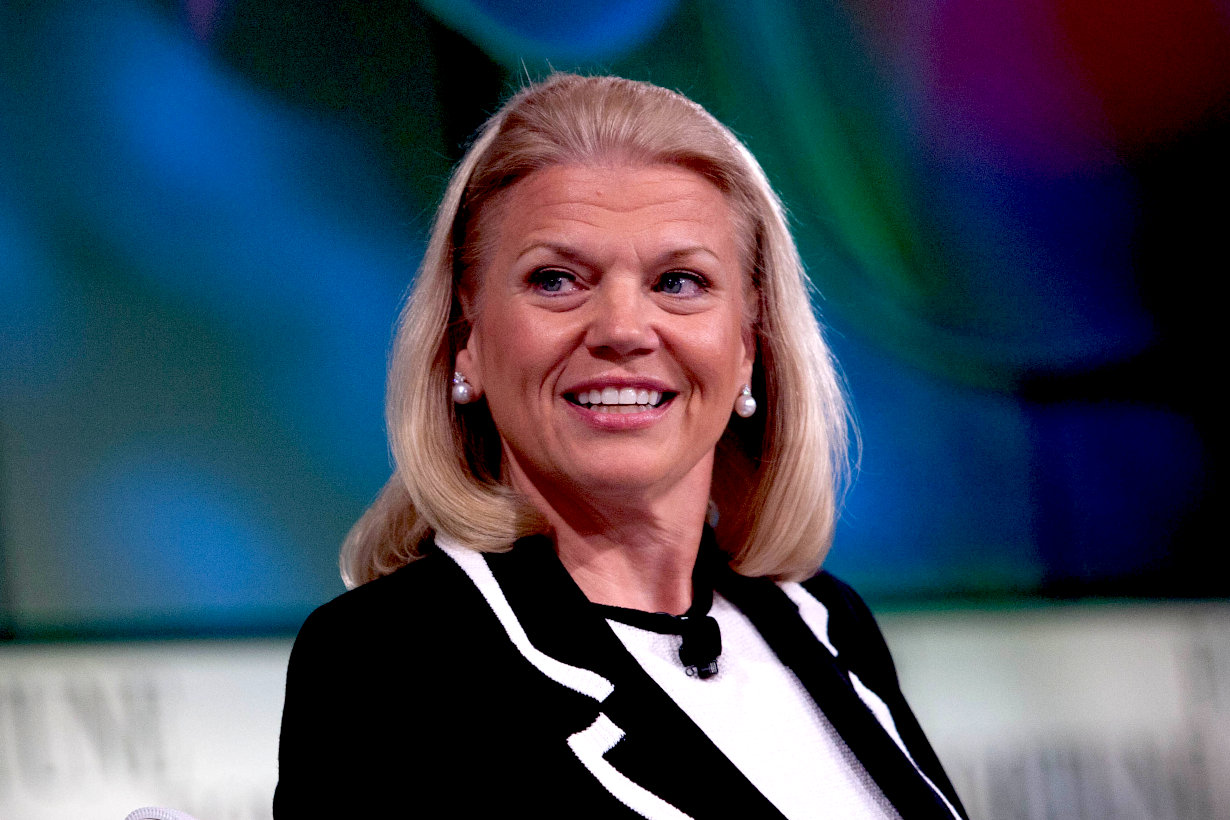
Photo credit: Asa Mathat / Fortune Live Media / Wikimedia Commons / CC BY 2.0 (link)