

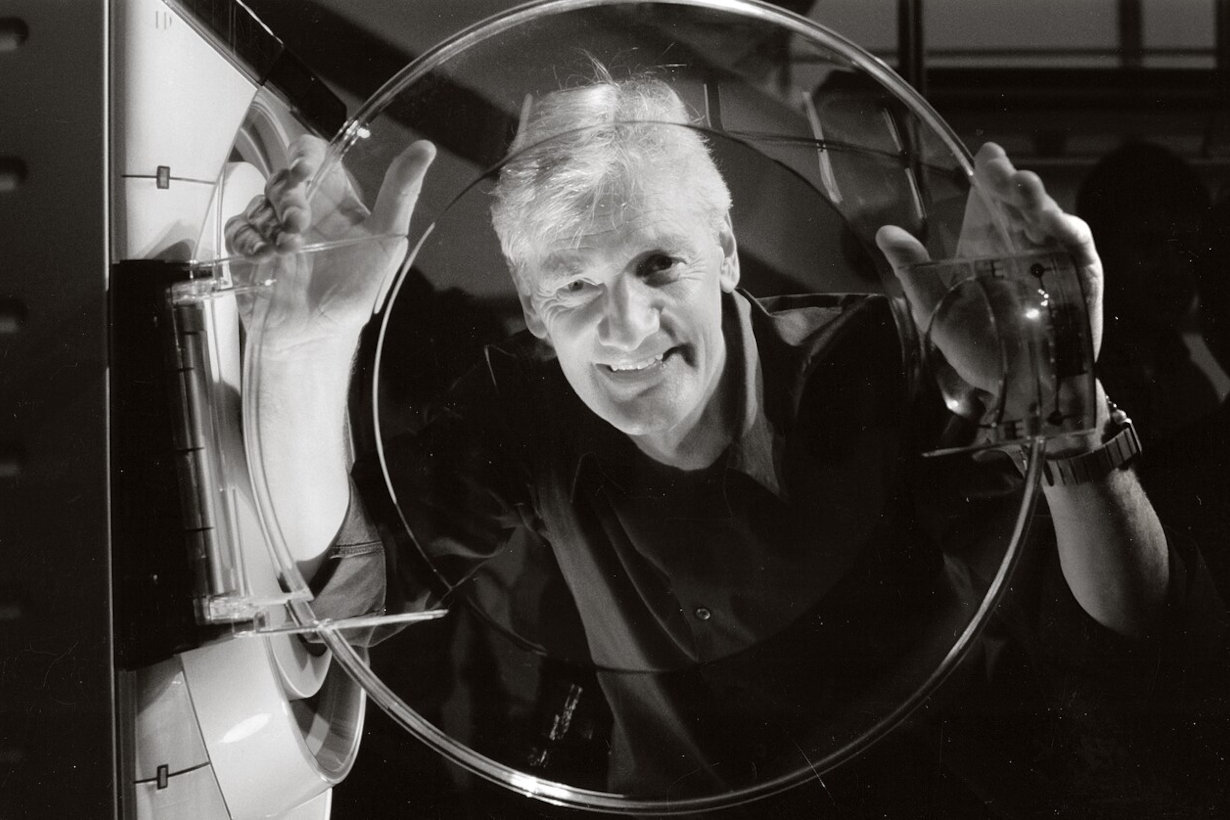
Every founder story begins with a problem, but only a few begin with genuine irritation. James Dyson did not set out to build a global consumer technology company; he set out to fix something that annoyed him every time he used it. That quiet dissatisfaction would eventually become the foundation of one of the world’s most distinctive product-driven businesses.
Key Takeaways
- Founders often discover their best ideas through personal frustration rather than market analysis.
- Long development cycles can be a strategic advantage when paired with deep conviction.
- Founder control matters most when product integrity is non-negotiable.
- Engineering-led companies scale differently, but often more durably.
- Persistence is only useful when paired with learning, not blind repetition.
When Frustration Becomes Obsession
In the late 1970s, vacuum cleaners all shared the same flaw: suction faded as the dust bag filled. Most consumers accepted this as inevitable. James Dyson (Sir James Dyson) did not. An industrial designer by training, Dyson became fixated on a simple question – why should a machine work worse the longer you use it?
That question refused to leave him alone. It followed him from his home to his workshop, slowly transforming irritation into obsession. What began as a personal experiment soon became a defining founder moment: the realization that the problem wasn’t minor, and that fixing it might require starting something entirely new.
5,127 Failures and One Conviction
Dyson’s breakthrough idea – using cyclonic separation instead of dust bags – was conceptually simple but brutally difficult to execute. Over five years, he built 5,127 prototypes, each one failing in some way. Motors overheated. Suction collapsed. Components broke under stress. Financial pressure mounted, and external validation was nonexistent.
Traditional companies weren’t interested. Manufacturers dismissed the idea as too radical or too expensive. Retailers doubted customers would pay more for a vacuum cleaner. At multiple points, walking away would have been the rational decision.
But Dyson wasn’t behaving like an employee pitching an innovation; he was acting like a founder with a belief system. Each failure sharpened his understanding of airflow, materials, and durability. What looked like stubbornness from the outside was, internally, a methodical process of elimination. Dyson wasn’t chasing novelty – he was chasing correctness.
That obsession with getting things right eventually revealed itself not just in products, but in intellectual property. Dyson has accumulated over 2,300 patents worldwide, drawn from more than 4,000 patent applications filed since 1979, covering technologies from vacuum systems and fan assemblies to hair dryers and hand dryers. With more than 1,200 registered designs and Dyson continuing to file over 450 patent applications annually, invention was never a phase in Dyson’s journey – it became the operating system of the company itself.
Why James Dyson Built His Own Company
After repeated rejections, Dyson made the decision that defines many great founders: if no one else would build it properly, he would. Founding Dyson Ltd. was not a growth play or branding exercise – it was a necessity. Only by controlling engineering, manufacturing, and design decisions could the product live up to his standards.
This choice shaped the company’s DNA from day one. Dyson wasn’t founded to compete on price or aesthetics alone; it was founded to prove that engineering excellence could be a commercial strategy. The company would not start with market research and work backward – it would start with physics, test relentlessly, and trust that customers would eventually follow.
From a Single Product to a Global Engineering Brand
The launch of the bagless vacuum cleaner changed Dyson’s life – but more importantly, it validated his founder instincts. Customers responded not just to better performance, but to the clarity of purpose behind the product. Dyson had built something that worked visibly better, and that difference was impossible to ignore.
From there, the company expanded carefully but confidently. Dyson applied the same engineering-first approach to fans, hand dryers, hair care devices, air purifiers, and beyond. Each category entry followed a familiar pattern: identify a flawed assumption, rebuild the product from first principles, and accept longer development cycles in exchange for meaningful differentiation.
As Dyson scaled globally, the company resisted the temptation to dilute its founder ethos. Research and development remained central, with thousands of engineers employed worldwide. Manufacturing decisions were made based on performance and learning speed, not short-term margins. Even as the brand became ubiquitous, it retained the feel of a founder-led organization – curious, skeptical, and deeply invested in problem-solving.
Why Dyson Never Became “Just Another Appliance Company”
What separates James Dyson from many successful founders is his refusal to transition into a symbolic role. He remained actively involved in design philosophy, engineering direction, and long-term strategy. This continuity mattered. It ensured that growth did not come at the expense of values.
Dyson’s founder identity also shaped how the company handled risk. Large bets – on new technologies, on proprietary motors, on unconventional product categories – were made not because they were fashionable, but because they aligned with the founder’s core belief: progress comes from questioning assumptions others ignore.
The Founder’s Real Advantage
James Dyson’s story challenges a popular startup myth – that speed and early traction matter more than depth. His journey suggests the opposite. Dyson spent years refining a single idea before it ever reached consumers, and that patience became his competitive advantage.
For founders, the lesson is uncomfortable but powerful: conviction is most valuable when it outlasts rejection. Dyson did not win because he moved fast; he won because he refused to accept incremental improvement as success.
More broadly, his story reminds founders that building a company is not about reacting to markets – it’s about shaping them. By committing to engineering excellence and owning the consequences of that commitment, Dyson built a business that reflects its founder’s mindset at every level.
FAQs
1. What motivated James Dyson to start his own company?
Dyson was driven by frustration with existing products and a belief that everyday tools could be fundamentally re-engineered. His decision to found his own company came from wanting full control over design, engineering standards, and long-term vision.
2. Why did James Dyson persist after thousands of failed prototypes?
Dyson viewed failure as a form of data rather than defeat, using each iteration to refine both product performance and manufacturing logic. This persistence shaped a company culture where experimentation was expected, not punished.
3. How did James Dyson’s founder mindset influence Dyson’s product philosophy?
As a founder, Dyson prioritized engineering integrity over market trends or short-term profits. This led to products that solved root problems first, even if they required longer development cycles or higher initial costs.
4. What makes Dyson different from other consumer hardware companies?
Dyson remained founder-led and engineering-driven at scale, resisting outsourcing core innovation. This ensured that design, testing, and problem-solving stayed central to the company’s identity rather than becoming secondary functions.
5. What can early-stage founders learn from James Dyson’s journey?
Dyson’s story shows that deep conviction often matters more than early validation. Founders can learn that building something truly differentiated may require time, isolation, and the courage to ignore conventional benchmarks.
Sources:
- https://en.wikipedia.org/wiki/James_Dyson
- https://nymag.com/vindicated/2016/11/james-dyson-on-5-126-vacuums-that-didnt-work-and-1-that-did.html
- https://www.jamesdysonfoundation.com/media/1gtn0jgi/standalone_ownyourideas.pdf
Photo credit: Michiel Hendryckx / Wikimedia Commons / CC BY-SA 3.0 (link)