

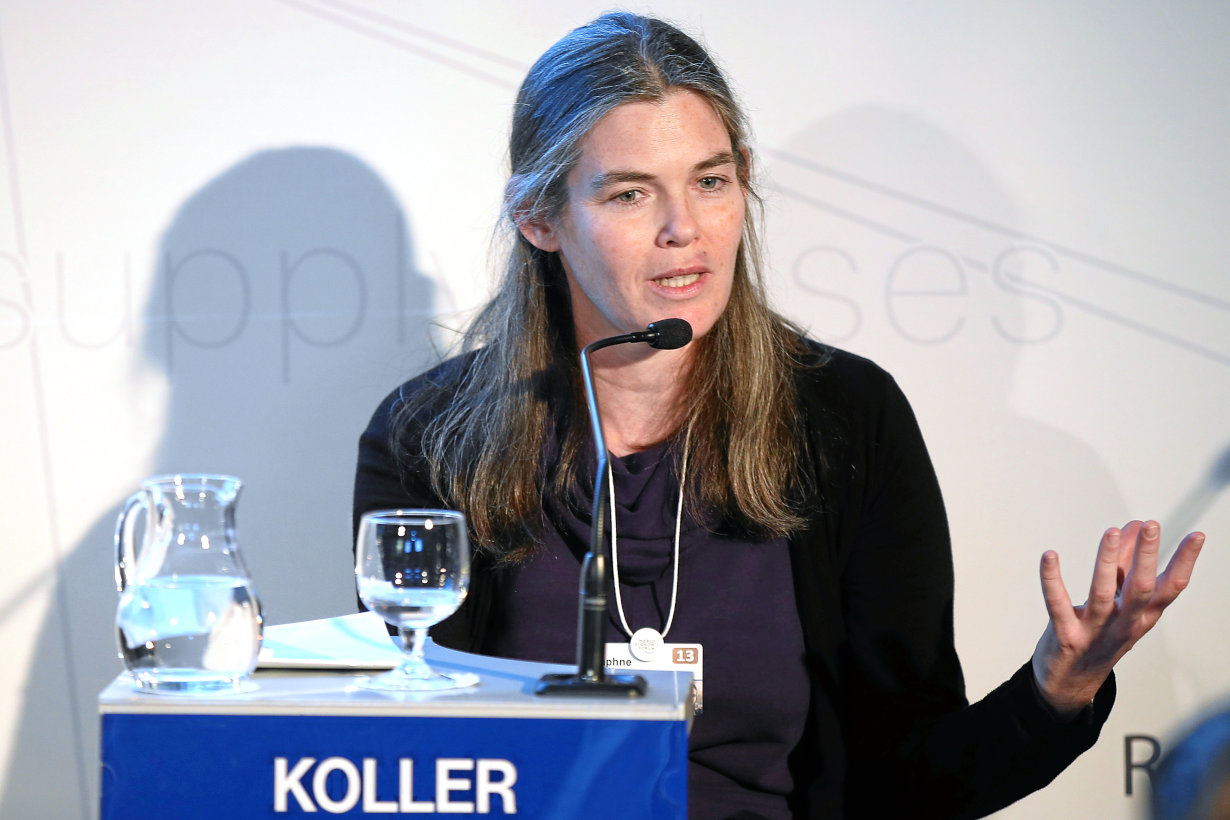
For decades, the biggest problem in medicine wasn’t imagination – it was probability. Drug discovery is slow, expensive, and dominated by failure. Daphne Koller, Founder and CEO of Insitro, believes artificial intelligence can change that equation, not by making scientists faster, but by making discovery itself more predictable.
Key Takeaways
- Drug discovery fails not mainly because chemistry is slow, but because we still fundamentally misunderstand the biology of many diseases we are trying to treat.
- Insitro uses artificial intelligence not just to optimize molecules, but to model disease mechanisms themselves and decide which biological targets are worth pursuing.
- The company’s core innovation is integrating large-scale data generation, machine learning, and laboratory validation into a single, continuously improving discovery system.
- By improving target selection early, this approach aims to prevent the kind of late-stage clinical failures that cost billions and waste years of scientific effort.
- If successful at scale, AI-driven biology could reshape not only how drugs are developed, but also the economics, risk profile, and ambition of the entire pharmaceutical industry.
Drug Discovery Is Broken – and AI Is Becoming the New Engine of Biology
Modern drug development is one of the most inefficient processes in science. It routinely takes more than a decade and billions of dollars to bring a single drug to market, and most candidates fail somewhere along the way. The majority of promising ideas die not because they are poorly conceived, but because biology is staggeringly complex, experiments are expensive, and humans are forced to make decisions with incomplete information.
For years, computers helped at the margins – simulating molecules, managing data, optimizing workflows. But Daphne Koller is part of a new wave of thinkers who argue something much more radical: AI shouldn’t just assist drug discovery. It should drive it.
Her company, Insitro, is built on a bold premise: that machine learning, trained on massive, carefully generated biological datasets, can uncover patterns in disease biology that humans simply cannot see – and in doing so, dramatically increase the odds of finding drugs that actually work.
If this vision holds, it doesn’t just improve R&D efficiency. It changes the economics, speed, and logic of how medicine itself is invented.
Why Drug Discovery Is So Slow, Costly, and Failure-Prone
At its core, drug discovery is a search problem in a universe of almost unimaginable complexity.
You start with a disease, try to identify the biological mechanism behind it, guess which target might influence that mechanism, search for a molecule that affects that target, and then spend years testing whether it works and whether it’s safe. At every step, uncertainty compounds.
The industry’s failure rates reflect this reality. Most drug candidates fail in clinical trials, often after hundreds of millions of dollars have already been spent. Many fail not because the chemistry is wrong, but because the underlying biological hypothesis was flawed.
This is the bottleneck Daphne Koller cares about most: we are bad at understanding disease mechanisms, and as a result, we chase the wrong targets far too often.
Traditional biotech has tried to solve this with more experiments, bigger screening libraries, and more automation. But these approaches still rely heavily on human intuition to decide which paths are worth pursuing.
Koller’s insight is that biology now generates enough data – and machine learning is now powerful enough – that we can begin to model disease itself in a fundamentally new way.
Daphne Koller: From AI Pioneer to Rebuilding Biotech from First Principles
Before Insitro, Daphne Koller was already one of the most influential figures in artificial intelligence.
She spent years as a Stanford professor helping define modern probabilistic machine learning. She co-founded Coursera to bring high-quality education to millions globally. In both cases, her work focused on taking complex systems and making them more navigable through computation.
But around the mid-2010s, her attention shifted decisively to biology.
What she saw was a field drowning in data – genomics, proteomics, imaging, phenotypic screens – but still making decisions largely the way it had for decades: with small samples, simplified models, and heavy reliance on expert intuition.
At the same time, machine learning had proven it could master complexity in domains like vision, language, and games. The gap between what AI could do in software and what it was being asked to do in biology began to look artificial.
Insitro was founded to close that gap.
Teaching Machines to Read Biology, Not Just Chemistry
Most previous attempts to use AI in drug discovery focused on chemistry: generating molecules, predicting binding, optimizing structures. Insitro starts somewhere more fundamental: understanding disease biology itself.
The company’s model is built around three tightly integrated components:
- High-quality, large-scale biological data generation
- Machine learning models that learn directly from that data
- A wet lab that continuously validates and feeds results back into the system
Instead of relying on messy, heterogeneous public datasets, Insitro designs experiments specifically to generate data that machine learning systems can learn from. This includes large-scale cellular perturbation experiments, rich phenotypic measurements, and carefully controlled biological systems.
The goal is not just to predict outcomes, but to infer causal relationships inside biological systems.
In practical terms, this means identifying which genes and pathways actually drive disease, predicting which targets are most likely to succeed before entering the clinic, and designing programs with much higher prior probability of working.
In effect, Insitro is trying to move drug discovery from an art guided by experience to an engineering discipline guided by models.
Why This Is Different from “AI Hype in Biotech”
Biotech is full of AI promises. Many of them amount to little more than faster versions of existing tools.
What makes Insitro different is that AI is not a layer on top of the pipeline – it is the pipeline.
The company doesn’t start with a target and then use AI to optimize around it. It starts with data, builds models of disease, and lets those models propose what the right targets should be.
This shift moves discovery from hypothesis-first to model-first, from intuition-driven selection to probability-driven prioritization, and from linear pipelines to closed feedback loops between data, models, and experiments.
Changing the Economics of Medicine
If this approach works at scale, the implications are enormous.
Drug discovery today is constrained not just by science, but by risk economics. Because failure is so common and so expensive, companies are forced to chase well-trodden targets, focus on incremental improvements, and avoid biologically ambitious programs.
A system that can reliably improve target selection would lower the cost of failure, increase the number of viable shots on goal, and make previously “too risky” diseases economically addressable.
This is especially important for complex, poorly understood conditions like neurodegenerative diseases, autoimmune disorders, and many rare diseases.
Owning the Discovery Engine, Not Just the Output
Unlike some biotech startups that exist to produce a single breakthrough drug, Insitro is being built as a innovation platform company – a continuously improving discovery engine.
The long-term value is not any one molecule, but the system that keeps generating better molecules.
This reflects a software-like worldview: the models get better as more data flows through them, each program improves the next, and discovery becomes a compounding capability.
When AI Becomes a Core Scientific Instrument
If the 20th century was defined by new physical instruments, the 21st century may be defined by computational instruments that reason about biology itself.
Daphne Koller’s work sits squarely in that transition.
In the long run, the real impact may not be faster drug pipelines alone, but a new way of doing science: one where models are not just tools for analysis, but active partners in discovery.
FAQs
Who is Daphne Koller?
She is a leading AI researcher, Stanford professor, co-founder of Coursera, and founder of Insitro.
Koller is widely regarded as one of the architects of modern probabilistic machine learning. Her career spans academia, education technology, and biotechnology, and she is known for building institutions, not just products. Insitro represents the culmination of her long-standing belief that AI should be applied to the hardest real-world scientific problems, not just digital ones.
What is Insitro?
Insitro is a biotech company using machine learning and large-scale biological data to discover new medicines.
Unlike traditional biotech firms that start with a specific target or molecule, Insitro is structured around a discovery engine that continuously generates, tests, and improves biological models. The company combines its own wet lab, data generation pipelines, and AI systems into a single integrated platform designed to improve the earliest and most failure-prone stages of drug development.
How is Insitro different from other AI biotech startups?
It uses AI to decide what biological targets to pursue, not just to design molecules.
Many AI-first biotech companies focus on optimizing chemistry after targets are chosen. Insitro shifts the application of AI upstream, into disease understanding and target selection, where most failures originate. This makes AI a strategic decision-maker in the pipeline, not merely a technical optimization tool.
Why is target selection so important?
Most drug failures happen because the biological hypothesis is wrong, not because the chemistry fails.
Once a drug enters clinical trials, the costs and timelines explode. If the underlying target is incorrect, no amount of chemical optimization can save the program. Better target selection improves the entire risk profile of R&D and allows companies to invest in more ambitious and scientifically novel programs with higher confidence.
Will AI replace scientists?
No. AI becomes a powerful scientific instrument that augments human reasoning and decision-making.
In Insitro’s model, scientists still define questions, design experiments, interpret results, and make strategic decisions. AI systems expand what humans can reason about by finding patterns in massive, high-dimensional datasets that no individual or team could analyze manually. The relationship is collaborative, not competitive.
Sources:
- https://en.wikipedia.org/wiki/Daphne_Koller
- https://time.com/7012718/daphne-koller/
- https://d3.harvard.edu/platform-digit/submission/insitro-discovery-new-medicines-with-ai/
- https://www.mckinsey.com/industries/life-sciences/our-insights/it-will-be-a-paradigm-shift-daphne-koller-on-machine-learning-in-drug-discovery
- https://www.youtube.com/watch?v=E3Ylz4sRXoA
Photo credit: World Economic Forum / Wikimedia Commons/ CC BY-SA 2.0 (link)