

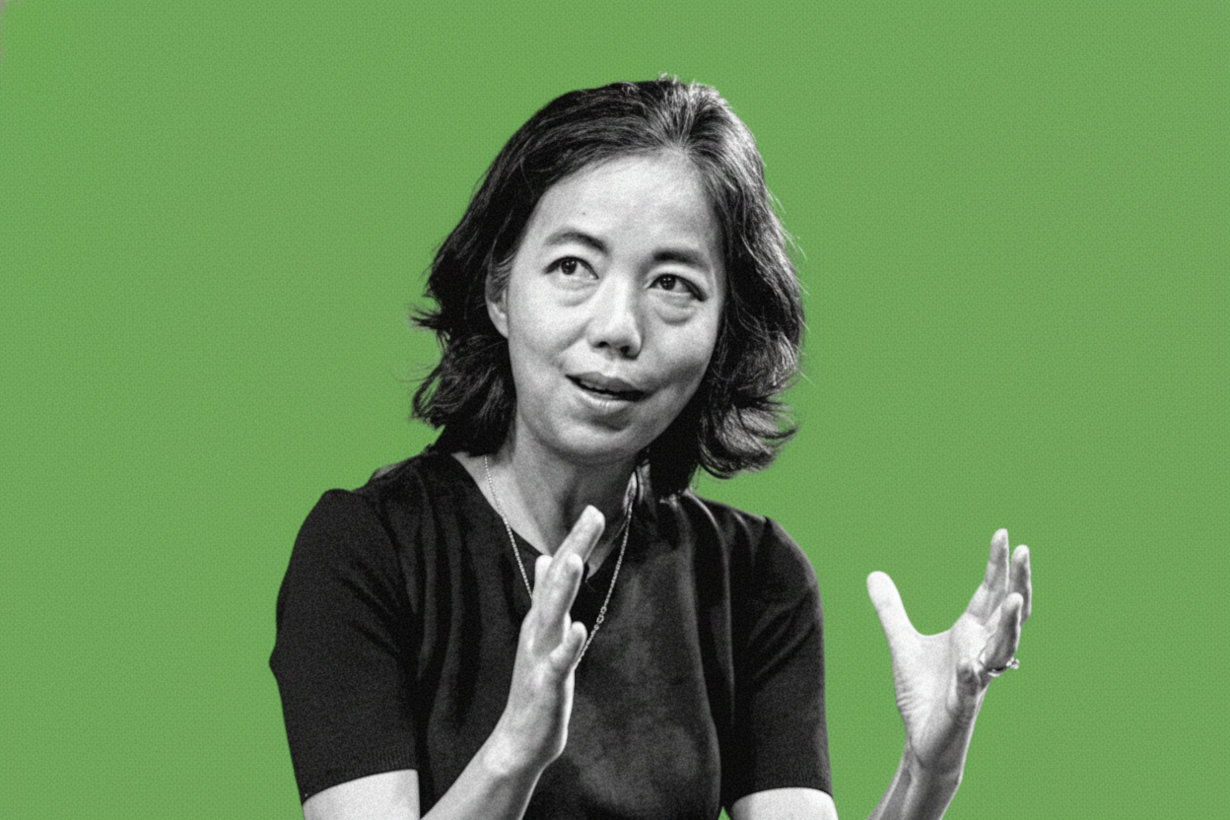
Fei-Fei Li, often called the “Godmother of AI,” is one of the most influential figures shaping modern artificial intelligence. Her groundbreaking work in computer vision, including the creation of ImageNet, laid the foundation for today’s deep learning revolution. Beyond research, she has guided AI’s ethical and societal adoption, influencing both academia and industry at the highest levels. This article explores how Li’s technical contributions evolved into a broader vision for human-centered AI – and why that perspective is becoming essential as AI systems move into everyday life.
Key Takeaways
- Large-scale, well-structured data – not just algorithms – was a decisive catalyst in modern AI breakthroughs.
- ImageNet reframed datasets as core scientific infrastructure, accelerating reproducible AI research.
- Computer vision’s rapid commercialization traces directly to benchmark-driven, data-centric innovation.
- Human-centered AI embeds ethics, governance, and accountability into system design – not after deployment.
- The future of AI depends as much on institutional stewardship as on technical capability.
Fei-Fei Li: Modern AI Advanced Not Only Through Algorithms, but Through Data, Design, and Governance
The evolution of artificial intelligence is often framed as a sequence of algorithmic breakthroughs: deeper neural networks, more efficient training methods, and ever-larger models. While these advances are significant, they do not fully explain why AI systems began to outperform previous approaches so dramatically in the past decade.
A critical factor in this transformation was the shift toward large-scale, well-structured datasets that allowed machine learning systems to learn from real-world complexity. Few figures have influenced this transition as directly as Fei-Fei Li, a computer scientist widely recognized as the “Godmother of AI”. Li’s creation of ImageNet, a large-scale, labeled dataset containing millions of images, provided the foundation for modern computer vision and deep learning models. By enabling algorithms to learn from diverse, real-world examples, her work accelerated AI research and practical applications across industries, from autonomous vehicles to healthcare diagnostics.
Beyond her technical contributions, Li has shaped the discourse on responsible AI, advocating for human-centered design, ethical frameworks, and governance practices that ensure societal benefit. Her leadership as director of Stanford’s AI Lab and co-founder of AI4ALL demonstrates a commitment not only to advancing AI technology but also to cultivating the next generation of AI researchers. Through these efforts, she has earned her reputation as a visionary who combines technical rigor with moral and societal stewardship.
Early Artificial Intelligence and the Data Bottleneck
Before the late 2000s, progress in artificial intelligence – particularly in computer vision – was slow and uneven. Models were typically trained on relatively small datasets, often curated manually and limited in diversity. As a result, systems performed well in narrow, controlled environments but failed to generalize to real-world conditions.
At the time, most research attention focused on algorithmic refinement rather than data infrastructure. Datasets were treated as supporting materials rather than core scientific contributions. This created a bottleneck: even as model architectures improved, performance gains plateaued due to insufficient exposure to varied, real-world examples.
Fei-Fei Li approached this challenge with a learning-centered perspective informed by cognitive science. Her view was straightforward but unconventional for the field at the time: visual intelligence – human or artificial – requires extensive experience. Without scale, diversity, and structure in training data, machine learning systems would remain fundamentally constrained.
ImageNet and the Shift to Data-Centric AI
In 2007, Li launched ImageNet, a project that would fundamentally alter the trajectory of artificial intelligence research. ImageNet was designed as a large-scale, hierarchically organized visual database containing millions of labeled images across thousands of object categories.
The innovation of ImageNet lay not only in its size, but in its design principles:
- A structured taxonomy aligned with linguistic hierarchies (WordNet)
- Consistent labeling across categories
- Public accessibility for academic research
- Benchmark competitions that encouraged reproducibility and comparison
By treating data creation as a first-class scientific contribution, ImageNet challenged prevailing assumptions within the AI research community. The dataset enabled models to learn visual representations from unprecedented levels of variation, capturing differences in lighting, orientation, context, and background that smaller datasets could not support.
The impact of ImageNet became unmistakable after the 2012 ImageNet Large Scale Visual Recognition Challenge, when a deep convolutional neural network achieved a dramatic reduction in error rates compared to prior systems. This result demonstrated that deep learning architectures, when paired with sufficient data, could outperform traditional methods by a wide margin.
This moment is widely regarded as a turning point in modern AI.
Accelerating Computer Vision and Industry Adoption
Following the success of ImageNet, data-driven deep learning approaches rapidly became the dominant paradigm in computer vision. Techniques validated through ImageNet benchmarks were adapted to a wide range of applications, including:
- Autonomous driving systems, where visual perception is critical for navigation and safety
- Medical imaging, enabling improved detection and classification of anomalies
- Robotics, supporting object manipulation and environment understanding
- Consumer technology, including image search, photo organization, and facial recognition
ImageNet also influenced research culture. Public benchmarks became standard practice, fostering transparency and accelerating progress through shared evaluation frameworks. Many of today’s foundational vision models trace their development lineage back to ImageNet-trained architectures.
Li’s work demonstrated that AI advancement depends not only on smarter models, but on infrastructure that supports learning at scale.
Institutional Leadership: Stanford and Google Cloud
As AI systems moved from research labs into widespread deployment, Fei-Fei Li’s influence extended beyond academia.
She joined Stanford University as a professor and later became co-director of the Stanford Institute for Human-Centered Artificial Intelligence (HAI). Stanford HAI was established to address the growing gap between AI capability and societal readiness, bringing together researchers from computer science, medicine, law, social sciences, and public policy.
The institute’s mission emphasizes:
- Interdisciplinary research on AI’s societal impact
- Responsible deployment of AI systems
- Governance frameworks aligned with democratic values
- Education and public engagement
From 2017 to 2018, Li served as Chief Scientist of AI and Machine Learning at Google Cloud, where she worked on advancing machine learning platforms for enterprise use. In this role, she also advocated for internal discussions on responsible AI development, particularly around fairness, accountability, and transparency.
Her leadership across academia and industry reflects a rare combination: deep technical credibility paired with institutional influence.
Human-Centered AI: Ethics as Engineering Discipline
A central theme of Fei-Fei Li’s work is the idea that artificial intelligence systems are shaped as much by human choices as by mathematical optimization. Data selection, labeling practices, deployment contexts, and governance mechanisms all influence how AI behaves in the real world.
Human-centered AI reframes ethics not as a constraint, but as a design requirement. Key principles include:
- Keeping humans meaningfully involved in high-stakes decision systems
- Designing for transparency and explainability
- Mitigating bias through data and evaluation practices
- Ensuring accountability for outcomes, not just intentions
This perspective has informed policy discussions, academic research agendas, and industry practices at a time when AI systems increasingly affect employment, healthcare, education, and civil society.
Li’s contribution is notable for integrating ethical considerations directly into the technical lifecycle of AI systems, rather than treating them as post-deployment concerns.
Sustainable Intelligence at Global Scale
As artificial intelligence systems continue to scale in capability and reach, the challenges they pose are no longer purely technical. Issues of trust, governance, and social alignment are becoming central to AI’s long-term viability.
Fei-Fei Li’s work suggests that the next phase of AI innovation will be defined by:
- Data quality and stewardship, not just data quantity
- Evaluation metrics that reflect societal impact
- Institutions capable of overseeing complex AI systems
- Collaboration between technologists, policymakers, and the public
Her career illustrates that durable innovation requires both scientific rigor and institutional responsibility. The systems that shape daily life for billions of people must be built with foresight, humility, and accountability.
In this sense, Fei-Fei Li’s influence on artificial intelligence extends beyond any single dataset or model. She has helped define the foundations upon which responsible, human-centered AI can continue to evolve.
FAQs
1. What is Fei-Fei Li best known for in artificial intelligence?
Fei-Fei Li is best known for founding ImageNet, a large-scale visual dataset that enabled breakthroughs in deep learning and computer vision.
2. Why was ImageNet so important to AI development?
ImageNet provided the scale and diversity of labeled data required for deep neural networks to outperform traditional computer vision methods.
3. What is human-centered artificial intelligence?
Human-centered AI is an approach that prioritizes human values, ethics, transparency, and societal impact alongside technical performance.
4. What role does Fei-Fei Li play in AI governance today?
She co-directs Stanford’s Human-Centered AI Institute, which focuses on responsible AI development, policy, and interdisciplinary research.
5. How has Fei-Fei Li influenced industry, not just academia?
Beyond academia, she served as Chief Scientist of AI at Google Cloud and has shaped industry discussions on ethical and scalable AI deployment.
Sources:
- https://en.wikipedia.org/wiki/Fei-Fei_Li
- https://profiles.stanford.edu/fei-fei-li
- https://www.businessinsider.com/fei-fei-li-world-labs-ai-childhood-immigrant-dry-cleaner-2025-11
- https://www.historyofdatascience.com/imagenet-a-pioneering-vision-for-computers/
- https://en.wikipedia.org/wiki/ImageNet
- https://tim.blog/2025/12/09/dr-fei-fei-li-the-godmother-of-ai/
- https://ai-4-all.org/about/our-story/
Photo credit: Atom7926 / Wikimedia Commons / CC BY 4.0 (link)