


Climate markets are growing rapidly, but trust in carbon credits has often lagged behind demand. Questions about verification, transparency, and double counting continue to undermine confidence in global offset markets. Irfon Watkins set out to address that gap by building a technology platform designed to make environmental assets verifiable and traceable at scale.
Key Takeaways
- Irfon Watkins co-founded DOVU to bring transparency and trust to carbon credit markets.
- DOVU tokenizes carbon credits so each credit can be tracked from creation to retirement.
- The company migrated from Ethereum to Hedera to gain faster, cheaper, and more sustainable infrastructure.
- Hedera’s hashgraph technology enables immutable audit trails and high-throughput transactions for environmental assets.
- Watkins stepped down as CEO and became chairman while Krasina Mileva assumed leadership of the company.
Turning Carbon Credits into Verifiable Digital Assets
Traditional carbon markets often rely on fragmented registries and opaque processes. Irfon Watkins envisioned a system where carbon credits could be tracked digitally from the moment they are generated – through verification, sale, and retirement – ensuring that every credit represents a measurable environmental outcome.
The result is a platform that blends climate finance with distributed ledger technology to bring accountability to environmental markets.
Through DOVU, Watkins helped pioneer a digital infrastructure that tokenizes carbon credits while creating transparent audit trails for every transaction.
The Founder Behind the Vision
Before launching DOVU, Watkins had already spent years building technology ventures focused on APIs, data infrastructure, and decentralized digital ecosystems. His entrepreneurial background shaped how he approached the carbon market – not simply as an environmental challenge, but as a data integrity problem.
When Watkins co-founded DOVU in 2017, the initial vision was to create a decentralized data marketplace connected to mobility ecosystems. Over time, however, the team recognized a far larger opportunity: bringing transparency to environmental assets such as carbon credits.
This shift reshaped DOVU’s mission.
Instead of focusing on mobility data, the company began building a trust layer for climate assets – a system that allows businesses, governments, and individuals to verify where their carbon credits originate and how they are used.
The Innovation: Tokenizing Carbon Credits
At the heart of DOVU’s technology is the tokenization of environmental assets.
Each digital carbon credit represents one ton of carbon dioxide removed or prevented from entering the atmosphere. By placing these credits on a distributed ledger, DOVU allows every step of the lifecycle – from measurement to retirement – to be recorded and verified.
This approach addresses several long-standing problems in carbon markets:
- Lack of transparency in credit generation;
- Limited traceability of credits once sold;
- Risk of double counting or fraud.
DOVU’s platform, often referred to as DOVU OS, enables carbon projects to be digitized and traded with verifiable data trails attached to every asset.
For Watkins, the goal was not just to create a marketplace, but to create the infrastructure that makes environmental markets trustworthy.
A Strategic Shift: From Ethereum to Hedera
One of the most important technical decisions in DOVU’s evolution was its move away from the Ethereum ecosystem toward the Hedera network.
The change reflected both technical and philosophical considerations.
Early blockchain infrastructure presented challenges for applications that require high transaction volumes and predictable costs. Ethereum’s network fees could fluctuate dramatically, sometimes reaching tens of dollars per transaction depending on network congestion.
For a platform built around potentially millions of micro-transactions involving carbon credits, that model was unsustainable.
Hedera offered several advantages:
- Low and predictable transaction fees, often less than one cent
- High throughput and fast transaction finality
- Enterprise-grade governance and reliability
Equally important for DOVU’s mission was Hedera’s environmental profile. The network’s hashgraph consensus mechanism uses far less energy than many traditional blockchain systems and is designed to be carbon-negative, aligning closely with DOVU’s sustainability goals.
For Watkins, the decision to migrate platforms was ultimately about alignment.
A company focused on climate impact needed infrastructure that reflected those values.
Hashgraph Technology and the Transparency Advantage
Hedera’s hashgraph consensus system also provides technical features that are particularly useful for environmental markets.
Through services like the Hedera Consensus Service, DOVU can create immutable timestamped records for every stage of a carbon project – from documentation and verification to trading and retirement.
These records create a tamper-proof audit trail.
For carbon markets, where credibility depends on accurate measurement and reporting, this capability is crucial. It allows buyers to verify that credits represent genuine environmental impact rather than unverifiable claims.
The result is a system where climate assets become not just tradable commodities but digitally verifiable environmental outcomes.
Scaling Climate Finance
DOVU’s technology is already being used to support large-scale environmental initiatives.
For example, the company has partnered on projects aimed at tokenizing billions of dollars worth of carbon assets tied to farmland regeneration and soil carbon capture. These initiatives use DOVU’s infrastructure to ensure that carbon credits remain traceable throughout their lifecycle.
Such projects highlight the broader ambition behind Watkins’ work.
The long-term goal is not simply to build another climate marketplace. It is to build the digital infrastructure that underpins the entire carbon economy.
Leadership Transition: Passing the CEO Role
As DOVU matured, Watkins made another significant decision – stepping down from the CEO role.
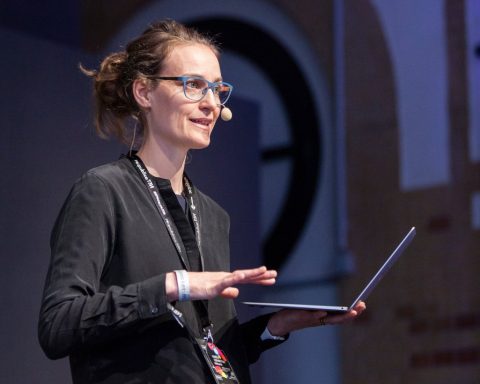
Leadership of the company transitioned to Krasina Mileva, who took over as chief executive while Watkins moved into the role of chairman. The transition allowed Watkins to focus more on long-term strategy, ecosystem development, and the broader vision behind DOVU’s technology.
Such founder transitions are not uncommon in technology companies that are entering a new phase of growth. Operational leadership shifts to executives focused on scaling the business, while founders concentrate on product direction and industry partnerships.
In Watkins’ case, the move reflected the next stage of DOVU’s evolution – from early-stage innovation to infrastructure capable of supporting large-scale climate markets.
Future Outlook: Infrastructure for the Climate Economy
As global carbon markets expand, the need for trusted infrastructure will only grow.
Businesses, governments, and financial institutions increasingly rely on carbon credits to meet sustainability commitments. But without transparent systems, those markets risk losing credibility.
Irfon Watkins’ work with DOVU represents one possible solution.
By combining tokenization, distributed ledgers, and verifiable environmental data, the platform aims to create a foundation where climate assets can be tracked with the same transparency as digital financial transactions.
If that vision succeeds, DOVU may become more than a technology company. It may become one of the key infrastructure layers for the emerging digital carbon economy.
FAQs
Who is Irfon Watkins?
Irfon Watkins is a technology entrepreneur and the co-founder of DOVU. He previously served as CEO and later transitioned to chairman while continuing to guide the company’s strategic vision.
What does DOVU do?
DOVU builds infrastructure that tokenizes carbon credits and environmental assets. The platform enables businesses and institutions to verify and track carbon credits with transparent digital records.
Why did DOVU move from Ethereum to Hedera?
The company migrated to Hedera because it provides lower and more predictable transaction fees, higher throughput, and faster finality compared with many traditional blockchain networks. These features make it more suitable for large-scale environmental marketplaces.
What is hashgraph technology?
Hashgraph is a distributed ledger consensus mechanism used by Hedera that allows fast, fair, and energy-efficient transaction validation. Its architecture supports high transaction volumes while maintaining transparency and security for enterprise-grade applications.
Why is transparency important in carbon markets?
Transparency ensures that carbon credits represent real and measurable environmental outcomes. Systems like DOVU’s create audit trails that verify where credits originate and how they are used, reducing the risk of fraud or double counting.
Sources:
- https://docs.dovu.earth/
- https://techcrunch.com/2017/08/29/jaguar-land-rover-is-backing-dovu-to-bring-the-blockchain-to-the-mobile-future/
- https://www.binance.com/en-IN/square/post/27388154881761
- https://hedera.com/learning/what-is-hashgraph-consensus/
- https://dovu.earth/en/the-new-ceo-of-dovu/
Photo credit: Irfon Watkins / LinkedIn