


Key Takeaways
- Jensen Huang built NVIDIA on a single insight: the GPU could process data like the human brain learns.
- NVIDIA’s innovation bridged gaming and AI – repurposing graphics chips for machine learning.
- By controlling both hardware and software, NVIDIA created an AI ecosystem few can rival.
- The company’s CUDA platform became the de facto language of AI computation.
- Huang’s leadership blends patience, technical depth, and relentless long-term focus.
The GPU That Rules Them All
In the race to build artificial intelligence, the world runs on NVIDIA.
Every major AI model – from ChatGPT to Tesla’s self-driving algorithms – depends on the same thing: GPUs, or graphics processing units. These chips, designed for rendering video games, have quietly become the infrastructure of intelligence.
At the center of this transformation stands Jensen Huang, NVIDIA’s co-founder and CEO, whose 30-year vision for parallel computing has turned a gaming startup into a trillion-dollar company.
The shift he catalyzed is more than technical – it’s architectural. Just as the steam engine powered the industrial age, GPUs now power the intelligence age.
From Gaming Graphics to Global Infrastructure
When Huang co-founded NVIDIA in 1993 with Chris Malachowsky and Curtis Priem, their goal was modest: build a processor that could render 3D graphics faster than the central processing units (CPUs) used in PCs.
At the time, the idea of a specialized “graphics card” was niche. Personal computers were CPU-dominated; 3D graphics were for arcades and consoles.
But Huang – a Taiwanese-born engineer who had worked at LSI Logic and AMD – saw something the industry missed: parallelism.
Unlike CPUs, which process tasks sequentially, GPUs handle many operations simultaneously.
That made them ideal not only for games, but also for any task that required matrix-heavy computation – like simulating physics, training neural networks, or rendering scientific visualizations.
Huang famously described this as a “time machine for computation.” It could turn week-long jobs into overnight results.
The company’s early chips, like the RIVA 128 (1997) and GeForce 256 (1999), defined consumer gaming performance. But the true turning point came in 2006, when NVIDIA released CUDA (Compute Unified Device Architecture) – a software toolkit that let developers program GPUs for general-purpose computing.
That was the moment GPUs stopped being just for gamers – and became the workhorses of AI research.
The GPU as The Brain of The Machine Age
The magic of NVIDIA’s innovation lies in repurposing.
By allowing GPUs to be reprogrammed for machine learning, NVIDIA created a foundation for the deep learning revolution that began in the 2010s.
The breakthrough came in 2012, when Alex Krizhevsky’s AlexNet – trained on GPUs – won the ImageNet competition by a record margin. The AI community suddenly realized: GPUs weren’t just for rendering images; they could understand them.
From there, NVIDIA’s ecosystem exploded:
- CUDA became the lingua franca of AI computing, giving NVIDIA dominance in developer adoption.
- DGX servers integrated GPU clusters for enterprise AI research.
- Tensor Cores, introduced in the Volta architecture (2017), optimized matrix multiplications for deep learning.
- NVLink enabled GPU-to-GPU communication at previously impossible speeds.
By 2025, NVIDIA controlled 86% of the global AI chip market, according to SQ Magazine. Its data center segment alone generated $47.5 billion in revenue in FY 2024, up 217% year-over-year increase.
Unlike competitors that sold hardware as a product, NVIDIA built an ecosystem – developers, cloud providers, and researchers – bound together by software compatibility.
That ecosystem lock-in is the true innovation: a fusion of hardware precision and software universality.
How it Affects Businesses and Society
The ripple effect of NVIDIA’s innovation extends far beyond Silicon Valley.
1. The AI Explosion
Every large language model, from OpenAI’s GPT-4 to Google’s Gemini, trains on thousands of NVIDIA GPUs. In 2024, OpenAI reportedly used over 20,000 H100 GPUs to train its latest model (The Information, 2024).
Without NVIDIA’s chips, AI research would slow to a crawl – or cost exponentially more in time and energy.
2. Enterprise Transformation
Industries from automotive to pharmaceuticals now depend on GPU computing:
- Healthcare uses GPUs for protein folding simulations and diagnostics (DeepMind’s AlphaFold).
- Manufacturing uses NVIDIA’s Omniverse for digital twins – virtual factories that optimize real-world efficiency.
- Automotive companies like Mercedes-Benz and Tesla build autonomous driving systems using NVIDIA DRIVE.
By integrating simulation, vision, and decision-making, NVIDIA has blurred the line between physical and digital industries.
3. Economic and Environmental Scale
As of 2025, NVIDIA’s market capitalization exceeds $1.9 trillion, placing it among the five most valuable companies globally, according to Bloomberg.
The economic footprint extends globally – through cloud providers like AWS, Azure, and Google Cloud, all of which rely heavily on NVIDIA’s GPU clusters for AI workloads.
Still, the company faces sustainability challenges. GPU energy use and semiconductor manufacturing’s environmental footprint are growing concerns. NVIDIA’s own sustainability reports highlight investments in energy-efficient architectures and renewable-powered data centers to address this.
4. Talent and Culture
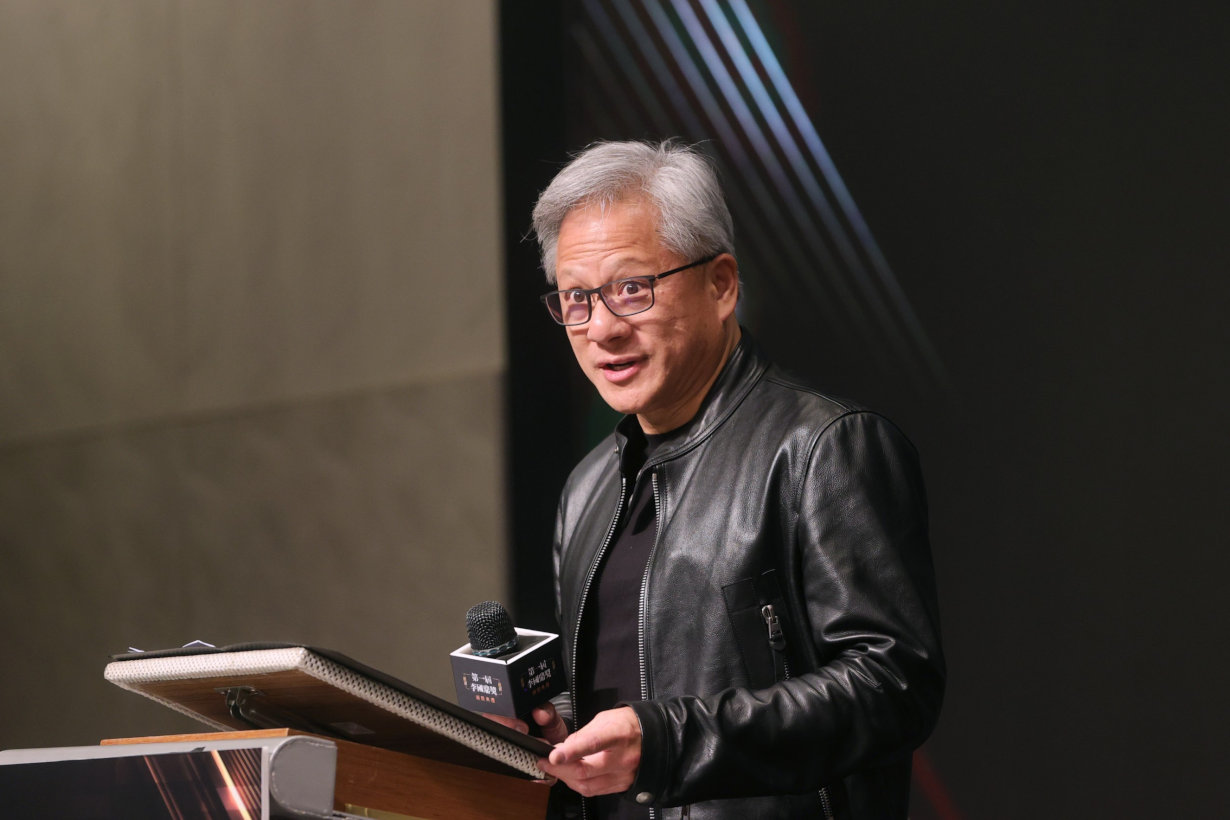
Huang’s leadership style has become a study in long-term focus. He has famously worn the same black leather jacket on stage for over a decade – a symbol of consistency and identity.
Inside NVIDIA, he’s known for pushing “no shortcuts” culture – the belief that breakthroughs happen only when teams master fundamentals.
“The most important thing in life,” Huang said at Stanford in 2023, “is to not give up your time machine – your chance to learn the hard things.”
The Next Computing Paradigm
The next era of NVIDIA’s innovation aims beyond chips. Huang envisions a full-stack AI infrastructure – from silicon to software to systems.
- AI Factories: NVIDIA’s 2025 initiative with Dell and Foxconn aims to build “AI factories” – data centers that continuously train and deploy AI models, much like electricity grids distribute power.
- Generative AI Hardware: The company’s latest Blackwell architecture (2025) features 208 billion transistors and is designed specifically for generative AI workloads, promising 2.5× performance per watt improvement over the H100 series.
- The Omniverse Future: NVIDIA’s Omniverse and Earth-2 initiatives simulate complex systems like climate and global supply chains, suggesting a new kind of computational modeling where AI, physics, and visualization merge.
- Competition and Decentralization: As AI accelerates, NVIDIA faces pressure from AMD, Intel, and startups like Cerebras and Graphcore. But its advantage lies in developer loyalty and a mature ecosystem that no rival yet matches.
Industry analysts predict the global AI hardware market will reach $341 billion by 2032 (Allied Market Research, 2025), with NVIDIA expected to retain leadership through 2030.
“We are at the beginning of a new computing era,” Huang told investors in 2025.
“The GPU has become the engine of modern AI – and AI will become the engine of every industry.”
FAQs
1. How did Jensen Huang’s GPUs become critical to AI?
Because GPUs are massively parallel processors ideal for matrix and tensor calculations – the mathematical core of deep learning.
2. What percentage of the AI chip market does NVIDIA control?
Estimates range from 80% to 95% of the market for AI accelerators (TrendForce, 2024).
3. What is CUDA, and why is it important?
CUDA is NVIDIA’s proprietary software platform that lets developers program GPUs directly – giving the company a massive competitive moat.
4. What are NVIDIA’s next big bets?
AI factories, generative hardware (Blackwell GPUs), and the Omniverse digital twin platform that unites physics, AI, and 3D graphics.
5. What leadership lessons define Jensen Huang?
Vision, persistence, and the courage to bet early on an idea others dismissed – that graphics chips could power the world’s intelligence.
Sources:
- https://en.wikipedia.org/wiki/Jensen_Huang
- https://www.linkedin.com/posts/aishwarya-m-353583279_jensen-huang-a-gpu-is-a-time-machine-because-activity-7289688900342583296-jvgR/
- https://www.forbes.com/sites/gilpress/2025/05/05/nvidia-builds-an-ai-superhighway-to-practical-quantum-computing/
- https://en.wikipedia.org/wiki/Alex_Krizhevsky
- https://www.euronews.com/business/2025/11/25/nvidia-shares-slip-as-ai-accelerator-race-shifts-interest-to-google-chips
- https://sqmagazine.co.uk/ai-chip-statistics/
- https://nvidianews.nvidia.com/_gallery/download_pdf/65d669a33d63329bbf62672a/
- https://www.bloomberg.com/news/articles/2025-10-29/nvidia-set-to-become-first-5-trillion-firm-as-ai-rally-extends
- https://www.cnbc.com/2024/09/19/tiaa-ceo-shares-top-career-advice-helped-her-get-ahead.html
- https://www.cnbc.com/2025/11/25/nvidia-says-its-gpus-are-a-generation-ahead-of-googles-ai-chips.html
- https://www.tomshardware.com/pc-components/gpus/nvidia-is-building-100-ai-factories-jensens-50-year-gambit-begins
- https://developer.nvidia.com/blog/inside-nvidia-blackwell-ultra-the-chip-powering-the-ai-factory-era/
- https://cambrian-ai.com/nvidia-earth-2-leveraging-the-omniverse-to-help-understand-climate-change/
Photo credit: 總統府 / Wikimedia Commons / CC BY 2.0 (link)