

Scaling a technology company is difficult. Scaling one that must negotiate with artists, record labels, regulators, and consumers simultaneously is something else entirely. Daniel Ek’s leadership at Spotify offers a case study in navigating layered stakeholder tension without losing strategic direction.
Key Takeaways
- Daniel Ek demonstrates that strong leaders act on conviction before consensus forms around their ideas.
- Spotify’s success shows that redesigning a business model can be more transformative than improving product features.
- Effective leadership balances data-driven decision-making with long-term strategic vision.
- Platform thinking enables companies to scale influence beyond a single product or service.
- Enduring industry disruption requires resilience, patience, and the discipline to stay focused on structural change.
Leadership in a Multi-Stakeholder Arena
Many founders build in markets where customer and product alignment drive success. Music streaming is different. It sits at the intersection of creators, rights holders, listeners, advertisers, and global regulators.
From its earliest days, Spotify had to balance competing interests. Listeners wanted affordable access. Artists wanted fair compensation. Record labels wanted control and revenue security. Governments scrutinized licensing and competition issues.
In this environment, leadership is not simply about product excellence. It is about structural negotiation.
Daniel Ek’s defining leadership trait has been sustained conviction in a long-term vision – even when short-term criticism intensifies from multiple sides. The premise is clear: Complex ecosystems require clarity of direction, not reactive management.
Building Legitimacy in a Resistant Industry
When Spotify launched in Europe in 2008 and later expanded globally, the music industry was still recovering from piracy-driven revenue collapse. Digital distribution had damaged trust between technology platforms and rights holders.
Ek did not position Spotify as a disruptor determined to bypass labels. Instead, he framed the company as a licensed partner designed to create a legal, scalable alternative to piracy.
This positioning, however, required patience.
Negotiations were long. Licensing agreements were costly. Expansion moved country by country, constrained by regulatory and contractual realities.
Rather than chasing rapid, uncontrolled growth, Ek prioritized legitimacy. He built relationships with major labels and structured revenue-sharing models that aligned incentives over time.
That discipline paid off. Spotify became the dominant global audio streaming platform, reshaping how music is distributed and monetized.
The lesson was not speed at any cost. It was structured scale within a fragile ecosystem.
Lesson #1: Vision Must Outlast Criticism
Spotify has faced recurring criticism – from artists over payouts, from competitors over exclusivity strategies, and from public voices over content moderation decisions.
Ek’s leadership pattern has been consistent: defend the long-term model while adjusting tactically where necessary.
He has maintained that streaming expands the total music market, even if distribution formulas remain debated. Whether one agrees or disagrees with specific policies, his steadiness reflects an important leadership principle: volatility in feedback cannot dictate volatility in strategy.
Executives operating in public markets must absorb pressure without allowing it to fragment direction.
Conviction, when paired with data and iterative refinement, stabilizes organizations in contested industries.
Lesson #2: Platform Leadership Requires Incentive Design
Spotify is not just a product company; it is a marketplace connecting creators and listeners.
Ek’s leadership emphasizes incentive alignment. Royalty structures, playlist algorithms, podcast investments, and creator tools are all mechanisms that influence behavior within the ecosystem.
Platform leaders must think beyond features. They must design economic relationships.
This systems-level thinking separates transactional leadership from architectural leadership. It requires understanding second-order effects: how one policy adjustment ripples across creators, consumers, and partners.
For executives in other industries, the takeaway is clear: If your business connects multiple stakeholder groups, your primary leadership function is incentive calibration.
Lesson #3: Global Scale Demands Operational Discipline
Spotify operates across dozens of countries, each with unique regulatory frameworks and cultural consumption patterns.
Ek resisted the temptation to treat international expansion as simple replication. Instead, Spotify invested in local partnerships, regional content strategies, and differentiated market entry tactics.
Leadership at global scale requires balancing standardization with localization. Over-centralization weakens relevance. Over-decentralization erodes efficiency.
Ek’s model demonstrates that durable expansion depends on structured flexibility – defining core principles while adapting execution to context.
Lesson #4: Founder Leadership Evolves With Maturity
Many founder-led companies face structural strain as they evolve from startup ventures into publicly traded corporations. Governance complexity increases, investor scrutiny intensifies, and organizational layers expand.
Daniel Ek’s leadership trajectory reflects this progression. After serving as CEO through Spotify’s scaling and public-market maturation, he transitioned to Executive Chairman on January 1, 2026 – signaling a shift from day-to-day operational leadership to longer-term strategic stewardship.
This move illustrates a different phase of founder influence. As companies institutionalize, sustaining impact often requires repositioning rather than relinquishing vision. Strategic communication, capital allocation discipline, and board-level governance become central levers of leadership.
The transition from founder-operator to executive chairman represents an evolution in responsibility rather than a withdrawal from influence.
Enduring relevance at scale requires adaptation without compromising the original strategic thesis.
Direction in a Noisy Market
Daniel Ek operates in one of the most scrutinized sectors of the digital economy, where cultural influence and commercial interests intersect. The music industry carries emotional significance for consumers while remaining economically complex for creators, labels, and platforms.
His leadership approach has been grounded in a consistent strategic premise: sustainable, legal streaming can expand the overall music market when incentives across stakeholders are properly aligned and supported by global scale.
In industries defined by competing interests, effective leadership depends less on visibility and more on strategic consistency. Directional clarity becomes essential when artists, rights holders, consumers, and investors operate with different priorities.
Within multi-sided ecosystems, the role of leadership is not to eliminate friction, but to design systems that manage it productively.
FAQs
1. Who is Daniel Ek?
Daniel Ek is the co-founder and Executive Chairman of Spotify, one of the world’s largest audio streaming platforms. He is known for transforming music consumption from ownership to access through a scalable subscription model.
2. What leadership challenge did Daniel Ek face in building Spotify?
Ek launched Spotify at a time when piracy was widespread and major record labels were deeply skeptical of streaming economics. His primary challenge was convincing the industry that subscription-based streaming could generate sustainable revenue while serving consumers better than illegal downloads.
3. How did Daniel Ek differentiate Spotify from competitors?
Rather than focusing solely on music storage or downloads, Spotify emphasized instant access, personalization, and discovery powered by data algorithms. This focus on user experience and platform design helped it stand apart from early digital music services.
4. What makes Daniel Ek’s leadership style distinctive?
Ek combines analytical rigor with long-term strategic conviction, often prioritizing durable ecosystem growth over short-term profitability. He is known for disciplined focus, product obsession, and willingness to withstand criticism while refining the model.
5. What can executives learn from Daniel Ek?
Executives can learn the importance of challenging entrenched industry norms, building platforms rather than standalone products, and aligning incentives across complex stakeholder groups. His approach demonstrates that redefining value creation can unlock entirely new market structures.
Sources:
- https://en.wikipedia.org/wiki/Daniel_Ek
- https://en.wikipedia.org/wiki/Spotify
- https://www.forbes.com/sites/stevenbertoni/2021/11/29/spotify-has-plans-to-move-beyond-music-and-become-the-instagram-and-tiktokofaudio/
- https://musictech.com/news/industry/spotify-royalty-payout-2026/
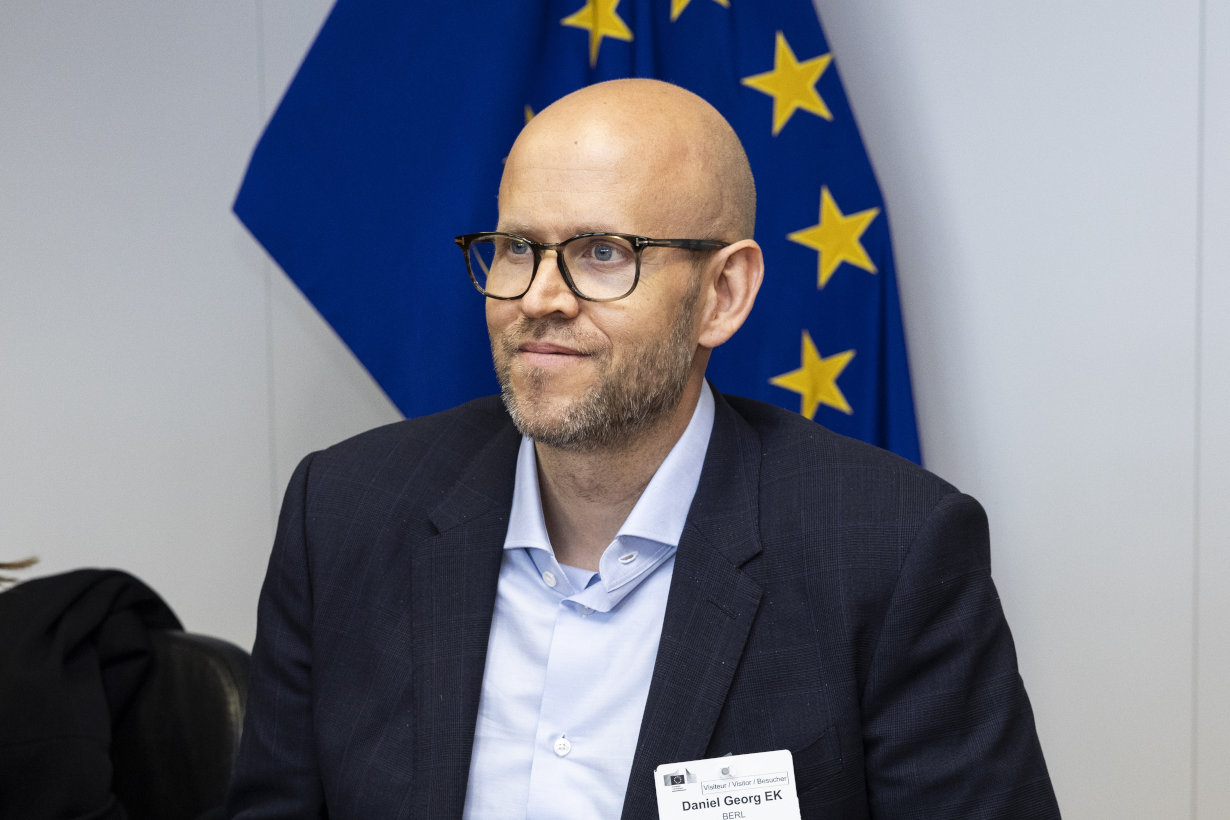
Photo credit: Lukasz Kobus / European Commission / Wikimedia Commons / CC BY 4.0 – cropped (link)