

Leadership is often judged by quarterly results, stock price reactions, and how confidently a CEO reassures the market. Indra Nooyi built her legacy by challenging that logic. During her tenure as CEO of PepsiCo, she made decisions that were deeply unpopular in the short term – but strategically unavoidable in the long run. Her story is a masterclass in what it means to lead when patience, not applause, is the real test.
Key Takeaways
- Long-term leadership demands the courage to accept short-term discomfort, especially when market pressure favors safer, more immediately rewarding choices.
- Conviction becomes a leadership strength only when it is paired with flexibility in execution and openness to informed dissent.
- Culture is not a soft concern but a strategic asset that determines whether ambitious transformations can actually be sustained.
- The most effective leaders are willing to stand alone when evidence and principle point toward a future others are not yet ready to accept.
- Leadership legacy is measured not by quarterly applause, but by how well an organization adapts to the world that follows.
Leadership Rooted in Conviction
Great leadership is not about pleasing everyone – it is about making decisions that will still make sense years after the criticism fades.
Indra Nooyi‘s leadership journey is defined by a rare willingness to absorb pressure in service of long-term value. At PepsiCo, she didn’t just manage a global consumer giant; she attempted to fundamentally reshape how success was measured. Her leadership lesson is not rooted in charisma or speed, but in conviction – the kind that holds steady even when markets disagree.
What makes Nooyi’s leadership especially instructive is that she pursued long-term transformation inside a company that was already successful. There was no crisis forcing change, no collapse demanding reinvention. Her challenge was subtler and harder: convincing stakeholders that success today did not guarantee relevance tomorrow. That tension – between present performance and future-proofing – is where many leaders hesitate, and where Nooyi chose to lead decisively.
Performance with Purpose
When Indra Nooyi became CEO of PepsiCo in 2006, the company was a powerhouse built largely on sugary drinks and salty snacks. Financially, the business was healthy. Strategically, it was vulnerable.
Consumer preferences were beginning to shift. Health concerns, regulatory scrutiny, and changing demographics signaled that PepsiCo’s core portfolio might not sustain growth forever. Many leaders in her position would have optimized for efficiency and incremental gains. Nooyi chose a harder path.
She introduced the idea of “Performance with Purpose” – a strategy that aimed to deliver strong financial returns while also investing in healthier products, environmental sustainability, and long-term social impact. It required reallocating capital, rethinking supply chains, and accepting lower margins in certain categories.
The response was mixed at best. Investors questioned whether PepsiCo was drifting from its core mission. Internally, the strategy demanded cultural change across a massive organization. For years, Nooyi faced criticism that her vision was diluting focus.
Yet she stayed the course.
This strategic shift also unfolded against the realities of operating at global scale. PepsiCo’s size meant that even modest changes rippled through suppliers, distributors, and regional markets. Every adjustment invited scrutiny, and every misstep was magnified. Nooyi was not just redefining product strategy; she was testing whether a legacy organization could absorb deep change without losing operational discipline. The leadership challenge was less about vision and more about endurance.
Insights from Indra Nooyi’s Leadership
1. Long-Term Leadership Requires Short-Term Pain
Indra Nooyi understood that transforming a global company would not show immediate rewards. Healthier products were more expensive to develop. Sustainable operations required upfront investment. Margins tightened before they improved.
Rather than retreating under pressure, Nooyi reframed leadership as stewardship – protecting the company’s relevance over decades, not quarters. She accepted that effective leadership sometimes looks like underperformance before it looks like progress.
Leadership takeaway: If every decision is optimized for immediate approval, long-term resilience is quietly eroded.
2. Conviction Is Not Stubbornness
One of Nooyi’s most misunderstood traits was her consistency. Critics labeled it rigidity. In reality, it was disciplined conviction paired with adaptability.
While she held firm on the strategic direction, she remained open to adjusting execution – acquiring brands, reshaping portfolios, and listening carefully to dissenting voices. Her leadership demonstrated that conviction does not mean refusing feedback; it means refusing to abandon purpose.
Leadership takeaway: Strong leaders separate what must not change from what must evolve.
3. Culture Is a Leadership Lever, Not a Side Project
Nooyi believed that strategy fails without cultural alignment. She invested heavily in leadership development, communication, and values – not as HR initiatives, but as business imperatives.
She famously wrote letters to employees’ parents, acknowledging their contributions and reinforcing a sense of dignity and responsibility. These gestures were not symbolic – they reinforced accountability, pride, and long-term commitment across a sprawling organization.
Leadership takeaway: Culture compounds strategy. Ignore it, and execution slowly decays.
4. Leadership Is the Willingness to Stand Alone
Perhaps the most defining aspect of Nooyi’s leadership was her comfort with isolation. She often found herself ahead of consensus – internally and externally.
Rather than chasing validation, she focused on coherence: aligning decisions with data, trends, and values. Over time, many of her bets – on snacks, emerging markets, and diversified portfolios – proved foundational to PepsiCo’s resilience.
Leadership takeaway: Leaders are often loneliest when they are right too early.
Closing: Choosing the Long Term, Wins
Indra Nooyi’s legacy is not a dramatic turnaround or a viral leadership moment. It is quieter – and more enduring.
She demonstrated that leadership maturity is the ability to hold tension: between profit and purpose, speed and sustainability, approval and responsibility. Her story reminds us that the best leaders are not always rewarded immediately – but they are recognized eventually, when the future arrives and the organization is still standing.
What ultimately sets Indra Nooyi apart is not that she predicted the future perfectly, but that she respected it enough to prepare for it. She understood that leadership is less about being celebrated in the moment and more about being accountable to what comes next. In an environment where leaders are often rewarded for confidence and speed, Nooyi’s restraint, patience, and moral clarity offer a quieter – but more durable – model of leadership. It is a reminder that the leaders who shape the future are often those willing to wait for it.
FAQs
What makes Indra Nooyi a strong example of leadership?
Her leadership is defined by long-term conviction under sustained pressure. She made decisions that were strategically sound but personally costly in the short term.
Why was “Performance with Purpose” controversial?
Because it challenged traditional profit-first thinking and required investments that did not immediately translate into higher margins or stock price gains.
Did Indra Nooyi’s strategy ultimately work?
Many of her portfolio and diversification decisions strengthened PepsiCo’s resilience and relevance, even if their value was only fully appreciated after her tenure.
What can current executives learn from Indra Nooyi?
That leadership is not about constant agreement – it is about responsibility, patience, and aligning decisions with future realities rather than present comfort.
Is Indra Nooyi’s leadership style still relevant today?
Yes. In an era of ESG pressure, stakeholder capitalism, and long-term risk, her approach looks increasingly prescient rather than idealistic.
Sources:
- https://en.wikipedia.org/wiki/Indra_Nooyi
- https://www.linkedin.com/in/indranooyi
- https://www.bcg.com/publications/2010/indra-nooyi-performance-purpose
- https://globalcoachgroup.com/indra-nooyis-quiet-leadership-that-transformed-pepsico/
- https://www.fuqua.duke.edu/dialogue-project-duke/indra-nooyi-companies-can-be-force-good
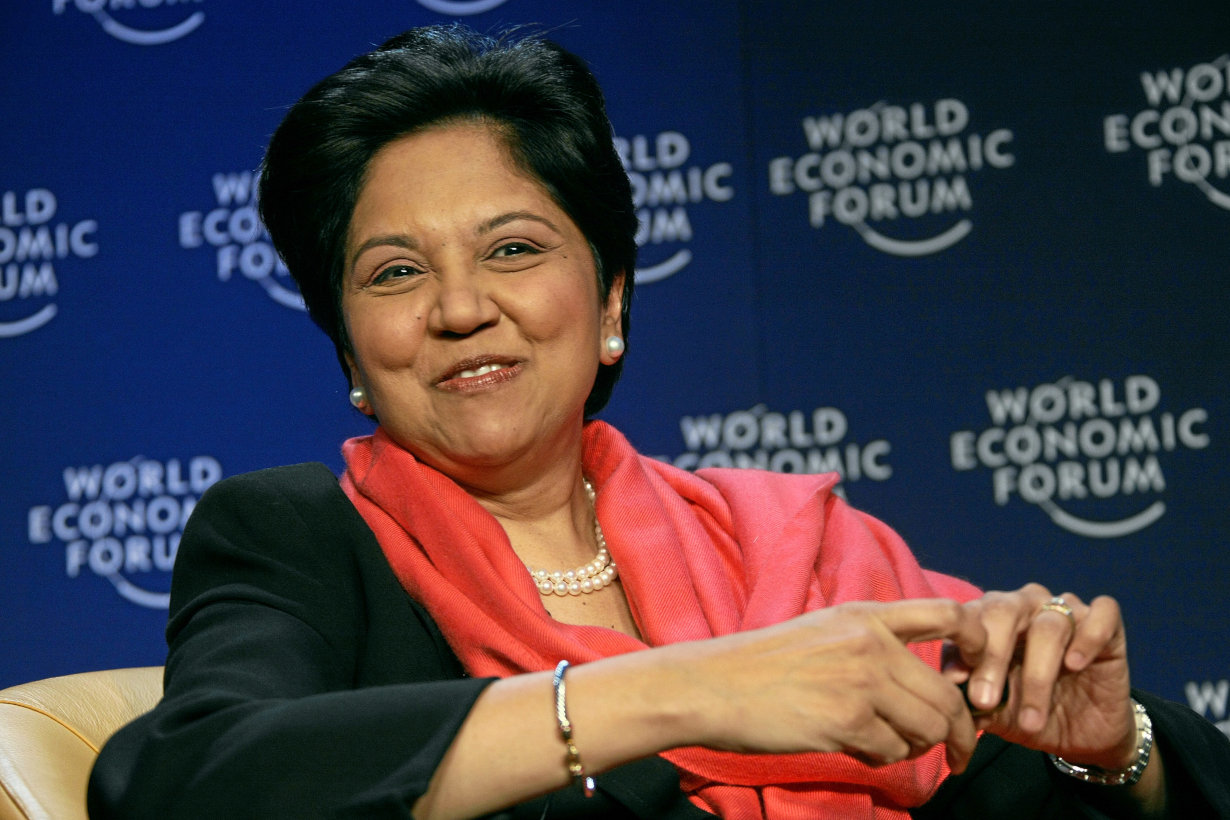
Photo credit: World Economic Forum / Wikimedia Commons / CC BY-SA 2.0 (link)