


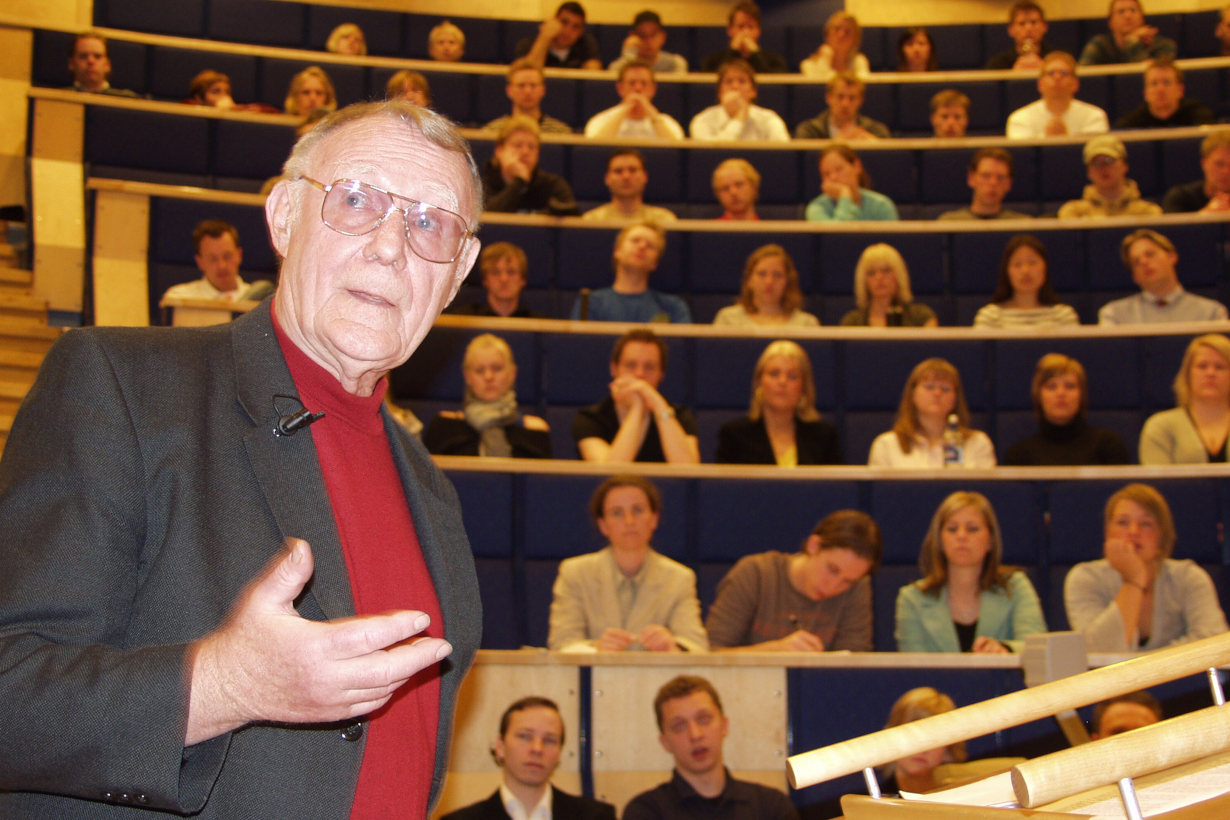
Leadership is often associated with abundance – big visions, bold spending, and visible authority. Ingvar Kamprad built one of the world’s most successful global companies by embracing the opposite. Through frugality, restraint, and an almost obsessive focus on simplicity, the founder of IKEA demonstrated how leadership values, when embedded deeply enough, can outlast founders, markets, and generations.
Key Takeaways
- Strategic constraints can sharpen innovation and focus when leaders treat limits as design principles rather than obstacles.
- Organizational culture becomes durable only when leaders model the values they expect, not merely communicate them.
- Simplicity is a long-term leadership commitment that must be actively protected as organizations scale.
- Reducing ego and hierarchy can improve speed, trust, and cost discipline across large organizations.
- The strongest leadership legacies are built through systems that function even when the founder steps away.
Limits Sharpen Thinking
Great leadership is not defined by how much freedom a leader has, but by the discipline of the constraints they choose to impose.
Ingvar Kamprad (1926-2018) believed that limits sharpen thinking. From the beginning, his leadership philosophy rejected excess – in cost, hierarchy, and ego.
IKEA was not designed to impress competitors or investors; it was built to serve customers who cared about affordability above all else. Kamprad’s leadership lesson lies in how deliberately he shaped behavior by restricting choices, forcing simplicity to become a competitive advantage rather than a compromise.
Kamprad’s leadership philosophy challenges a common assumption: that freedom enables creativity. He believed the opposite – that unlimited choice often leads to waste, confusion, and mediocrity. By narrowing options and enforcing discipline, he created clarity. Leaders at IKEA did not ask what they could do; they asked what they should not do. This inversion of leadership thinking – where saying no is as important as saying yes – became one of IKEA’s most enduring advantages.
Cost Discipline is a Cultural Thing
Ingvar Kamprad founded IKEA in Sweden in 1943, initially selling small household items before moving into furniture. The insight that defined IKEA’s model was deceptively simple: well-designed furniture should be affordable to ordinary people. Achieving that goal, however, required rethinking everything – from flat-pack design and self-assembly to global sourcing and warehouse-style retail.
Kamprad understood early that strategy alone would not sustain this model. Cost discipline had to become cultural. Employees were encouraged to fly economy, stay in modest hotels, and question unnecessary spending at every level. Kamprad himself embodied these values, famously driving an old Volvo and avoiding luxury long after he could afford it.
What made this leadership approach powerful was its consistency. Frugality was not a cost-cutting phase – it was a permanent operating principle. Over decades, these constraints compounded into a system that competitors struggled to copy without undermining their own cultures.
Kamprad’s insistence on frugality was sometimes misunderstood as personal eccentricity, but it was deeply strategic. Every saved cost reinforced IKEA’s promise to customers and protected its ability to operate at scale. Over time, these practices became rituals that signaled seriousness of purpose. Employees understood that waste was not merely inefficient – it was a breach of trust with customers. In this way, Kamprad transformed cost control from a financial exercise into a moral one, anchoring daily decisions to a larger mission.
Leadership Insights by Ingvar Kamprad
1. Constraint Can Be a Strategic Advantage
Ingvar Kamprad treated limitations as design inputs rather than obstacles. Lower prices forced innovation in packaging, logistics, and product design. Instead of asking how to make premium furniture cheaper, IKEA asked how to redesign furniture so cost efficiency was built in from the start.
This mindset reshaped decision-making across the organization. Teams learned to innovate within boundaries, not escalate budgets to solve problems.
By designing constraints into IKEA’s operating model, Kamprad forced innovation upstream. Designers had to think about packaging before aesthetics, logistics before finishes, and transportation before form. This reversed the typical product-development sequence and embedded cost discipline at the earliest stages. Leadership, in this case, was not about approving ideas – it was about designing the conditions under which better ideas would emerge.
Leadership takeaway: The right constraints don’t slow progress – they focus it.
2. Culture Is Strongest When It Is Lived, Not Announced
IKEA’s culture did not rely on slogans alone. Ingvar Kamprad lived the values he expected from others, making frugality visible and unavoidable. This consistency reduced cynicism and increased trust.
When leaders behave differently from the culture they promote, values become performative. Kamprad avoided this by turning everyday behavior into leadership signals.
Kamprad understood that culture spreads horizontally, not vertically. When employees saw leaders travel modestly, question expenses, and avoid privilege, those behaviors normalized humility across the organization. This removed the need for enforcement. Instead of compliance, IKEA achieved alignment. Leadership credibility grew not from speeches, but from the absence of contradiction between values and behavior.
Leadership takeaway: Culture scales when leaders embody it quietly and consistently.
3. Simplicity Requires Constant Leadership Attention
Simplicity is easy to claim and hard to maintain. As IKEA grew into a global giant, complexity threatened to creep in – from bureaucracy to brand dilution.
Ingsarn= Kamprad remained vigilant, reminding leaders that growth should never compromise clarity. His leadership reinforced that simplicity was not a phase of IKEA’s early years, but its enduring competitive moat.
As IKEA expanded globally, complexity became its greatest threat. New markets, regulations, and partnerships introduced friction that could easily erode simplicity. Kamprad treated complexity as a form of organizational debt – manageable in small amounts, dangerous when ignored. His leadership discipline lay in recognizing that growth without clarity ultimately weakens execution, no matter how impressive the numbers look.
Leadership takeaway: Simplicity doesn’t survive growth unless leadership actively defends it.
4. Ego Is a Hidden Cost
Kamprad believed ego was one of the most expensive forces in organizations. Titles, perks, and hierarchy inflate costs and slow decisions. IKEA’s relatively flat structure reflected his belief that humility was operationally efficient.
By minimizing status symbols, Kamprad kept attention focused on customers rather than internal politics.
Kamprad’s skepticism of ego was rooted in efficiency, not morality. He believed that hierarchy distorts information and slows decision-making. By minimizing status differences, IKEA encouraged honesty and problem-solving closer to the front line. Leadership, in this model, was not about commanding attention, but about removing friction so the organization could function smoothly without constant oversight.
Leadership takeaway: Ego quietly taxes organizations long before it visibly damages them.
Closing: Ingvar Kamprad’s Durable Legacy
Ingvar Kamprad’s leadership legacy is not flashy, but it is remarkably durable. IKEA did not win by outspending competitors or chasing trends; it won by embedding discipline so deeply that it became instinct.
In a world that often equates leadership with expansion and excess, Kamprad offers a counterexample: that restraint, when applied thoughtfully, can be one of the most powerful leadership tools available. His story reminds us that great leaders don’t just define what an organization pursues – they define what it deliberately refuses to become.
Ingvar Kamprad’s leadership endures because it was never dependent on him being present. IKEA’s culture continues to reinforce frugality, simplicity, and customer focus decades after its founder stepped back. This is perhaps the clearest measure of leadership success: when values persist not because they are remembered, but because they are operationally unavoidable. Kamprad didn’t just lead IKEA – he encoded leadership into its systems.
FAQs
What leadership lesson defines Ingvar Kamprad’s approach at IKEA?
Kamprad showed that discipline and restraint can be strategic assets. By embedding frugality into daily behavior, he aligned culture with long-term competitiveness.
Why was frugality so central to IKEA’s leadership model?
Because affordability was the company’s core promise. Frugality ensured that every decision reinforced customer value rather than internal comfort.
Did Kamprad’s leadership style limit IKEA’s growth?
No. In fact, it enabled scalable growth by keeping costs, complexity, and ego in check as the organization expanded globally.
How did Kamprad maintain culture as IKEA grew?
Through relentless consistency. He reinforced values through behavior, systems, and expectations rather than formal enforcement.
Is Ingvar Kamprad’s leadership style still relevant today?
Yes. In an era of rising costs and complexity, his emphasis on simplicity, humility, and constraint is increasingly relevant.
Sources:
- https://en.wikipedia.org/wiki/Ingvar_Kamprad
- https://mastersinvest.com/newblog/2023/2/3/learning-from-ikea
- https://www.facebook.com/EvanCarmichaelcom/posts/the-founder-of-ikea-was-famously-frugaldespite-being-worth-over-50-billion-ingva
- https://www.linkedin.com/pulse/10-things-i-learnt-from-ingvar-kamprad-natasha-holland/
Photo credit: Wikimedia Commons / CC0