

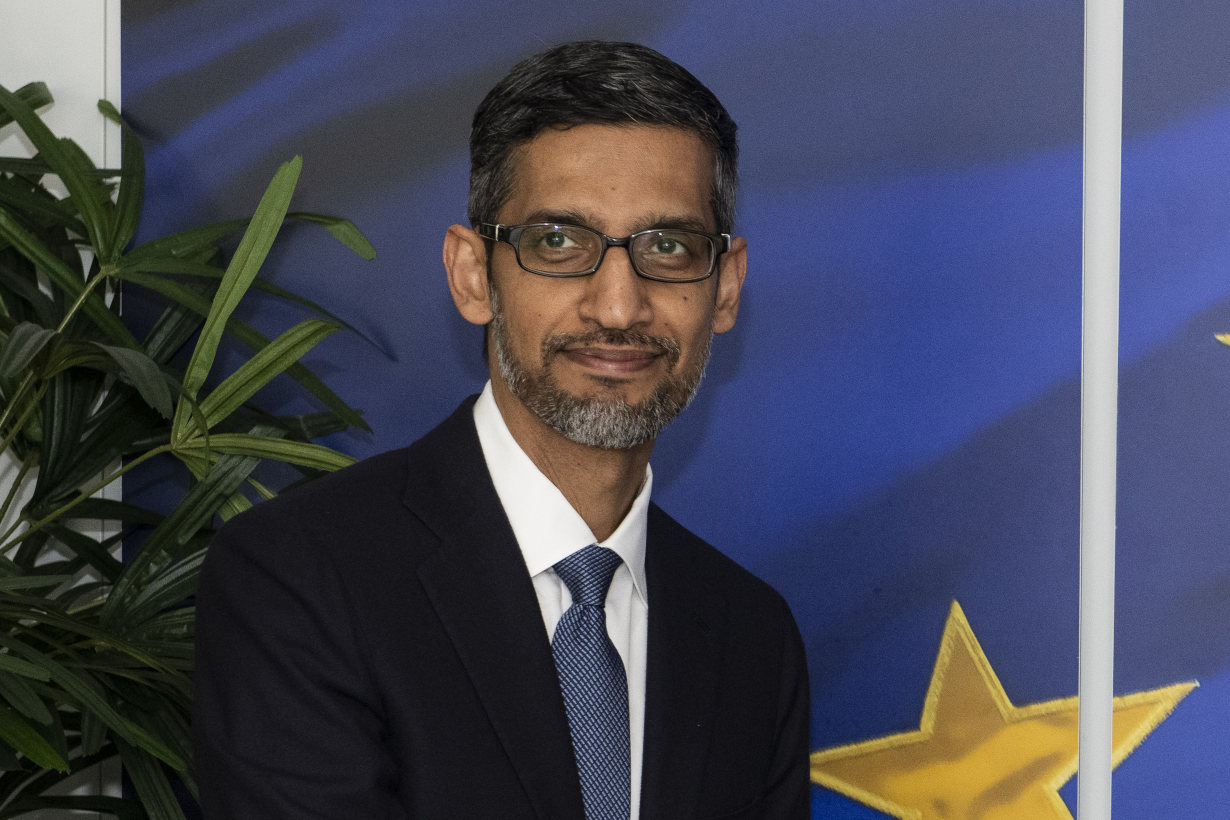
Sundar Pichai leads one of the world’s most influential technology companies with a quiet but deliberate hand. At Alphabet, the challenge isn’t moving fast – it’s exercising restraint when billions of users depend on every decision. His approach shows that at massive scale, leadership is less about spectacle and more about judgment, culture, and careful stewardship.
Key Takeaways
- At massive scale, restraint becomes a strategic leadership advantage.
- Culture, not policy, is the most scalable form of governance.
- Accountability builds credibility when certainty is impossible.
- Leadership judgment matters more than visionary rhetoric.
- Stewardship is the defining leadership skill of the AI era.
Leadership Without Theater
In an era where leadership is often confused with visibility, Sundar Pichai represents a quieter – and increasingly rare – model of power.
He does not dominate headlines through provocation. He does not perform leadership through bravado or spectacle. Yet few executives on the planet oversee systems that shape daily life at the scale he does. Search, mobile operating systems, cloud infrastructure, digital advertising, and now artificial intelligence – all sit under his stewardship.
Pichai’s leadership challenge is not how to move fast. It is how to move carefully when moving fast is the default expectation.
At Alphabet, speed is assumed. What is not assumed – and must be deliberately cultivated – is restraint.
This is the paradox of modern leadership at scale: when your decisions affect billions, the cost of certainty becomes higher than the cost of patience.
Power at Alphabet Scale
Sundar Pichai became CEO of Google in 2015 and CEO of Alphabet in 2019, inheriting not a scrappy startup but one of the most influential technology ecosystems ever built.
By the time he stepped into the role:
- Google Search shaped how the world accessed information.
- Android powered the majority of the world’s smartphones.
- YouTube had become a global media platform.
- Google Cloud was competing in enterprise infrastructure.
- AI research was deeply embedded across the company.
This scale brought scrutiny.
Alphabet operates under constant regulatory pressure across the U.S., Europe, and Asia. It faces antitrust challenges, content moderation dilemmas, data privacy concerns, and now existential questions about how AI systems should be deployed responsibly.
Unlike founders who define culture through origin stories, Pichai’s task was different: preserve trust while evolving power.
He was not hired to disrupt Google. He was hired to ensure it didn’t lose its moral center while becoming more powerful than ever.
Restraint Is a Strategic Advantage
In technology, the default instinct is acceleration. Ship faster. Scale faster. Monetize faster.
Pichai’s leadership suggests a counterintuitive truth: at extreme scale, restraint becomes a competitive advantage.
Nowhere is this clearer than in AI.
While Alphabet possesses world-class AI research capabilities, Pichai has consistently emphasized responsibility, safety testing, and staged deployment. This approach has drawn criticism from those who equate leadership with first-mover dominance. But Pichai understands the asymmetric risk: when mistakes occur at Google’s scale, they don’t remain product issues – they become societal ones.
Restraint, in this context, is not hesitation. It is risk management for civilization-level systems.
Leadership lesson: When your platform shapes behavior, slowing down is not weakness – it’s stewardship.
Culture Scales Faster Than Policy
One of Pichai’s most underappreciated leadership strengths is his belief that internal culture matters more than external rules.
Alphabet employs tens of thousands of engineers, researchers, and product leaders. No policy manual can anticipate every ethical decision they will face – especially in frontier technologies like AI.
Pichai has repeatedly reinforced principles rather than prescriptions: responsibility, user trust, long-term thinking, and humility in the face of complexity. These values are meant to guide decisions long before legal or regulatory frameworks catch up.
This philosophy reflects a deeper leadership truth: systems behave according to incentives and norms, not slogans.
By emphasizing values internally, Pichai attempts to ensure that judgment scales alongside innovation – a necessity when product decisions ripple outward to billions of users.
Leadership lesson: Strong cultures reduce the need for constant control.
Accountability Beats Certainty
Modern leaders are often expected to project confidence – even when certainty is impossible.
Pichai’s leadership style challenges this expectation.
He has acknowledged publicly that technology companies do not always get it right. Alphabet has faced legitimate criticism around misinformation, platform misuse, and the unintended consequences of scale. Rather than deny these realities, Pichai has leaned into accountability – expanding review processes, increasing transparency, and engaging with regulators and civil society.
This posture has not made Alphabet immune to criticism. But it has helped preserve credibility.
In an age where trust in institutions is fragile, admitting complexity is itself a leadership act.
Leadership lesson: Credibility compounds when leaders admit limits instead of pretending omniscience.
Leadership Is Judgment, Not Vision
Sundar Pichai is not known for sweeping visionary proclamations. His leadership is defined by judgment – when to invest, when to pause, when to push, and when to absorb criticism without reaction.
This mindset reflects his background as an engineer and product leader. He evaluates trade-offs and considers second-order effects. He understands that good decisions often look conservative in the short term and wise only in retrospect.
During periods of intense transformation – including workforce restructuring, shifting priorities toward AI, and navigating post-pandemic realities – Pichai has emphasized clarity over charisma.
What distinguishes Pichai’s judgment is not that it avoids risk, but that it recognizes where risk compounds invisibly. At Alphabet’s scale, a single decision can trigger regulatory backlash, cultural erosion, or unintended behavioral shifts across entire societies. Pichai’s leadership reflects an understanding that judgment is not about choosing the boldest path, but the most sustainable one – even when that choice invites short-term criticism. In this sense, his leadership favors durability over drama, and coherence over spectacle.
Leadership lesson: Vision matters, but judgment sustains organizations through uncertainty.
Stewardship as Modern Power
Sundar Pichai’s leadership may not inspire viral soundbites, but it reflects something more enduring: the discipline to lead powerful systems without becoming captive to them.
This form of stewardship also demands emotional discipline. Pichai operates in an environment where every decision is dissected in real time – by markets, media, governments, and internal teams. His ability to maintain equilibrium amid constant pressure underscores a central truth of modern leadership: power is no longer defined by control, but by responsibility under scrutiny. Pichai’s steadiness signals that leadership today is less about shaping narratives and more about holding institutions together as they evolve.
In an era where technology outpaces governance and influence outpaces accountability, Pichai represents a model of leadership rooted in restraint, responsibility, and long-term thinking.
He reminds us that leadership is not about commanding attention – it is about earning trust over time.
And at global scale, trust is the rarest advantage of all.
FAQs
1. What defines Sundar Pichai’s leadership style?
A calm, judgment-driven approach centered on responsibility, restraint, and long-term trust.
2. How does Pichai approach AI governance?
By emphasizing safety, staged deployment, internal review, and societal responsibility alongside innovation.
3. Is Sundar Pichai considered a “quiet leader”?
Yes – his influence comes from decision-making discipline rather than public performance.
4. How does Pichai manage Alphabet’s scale and scrutiny?
Through cultural principles, accountability mechanisms, and engagement with regulators and stakeholders.
5. What can other leaders learn from Pichai?
That leadership at scale is less about speed and more about judgment, restraint, and stewardship.
Sources:
- https://en.wikipedia.org/wiki/Sundar_Pichai
- https://en.wikipedia.org/wiki/Alphabet_Inc.
- https://www.linkedin.com/pulse/analysis-sundar-pichais-predominant-intelligences-ai-fernando-o5cdc
- https://www.businessinsider.com/sundar-pichai-google-alphabet-ceo-career-life
- https://ctomagazine.com/sundar-pichai-leadership-style/
Photo credit: (c) European Union, 2o25 / Lukasz Kobus (European Commission) / Wikimedia Commons / CC BY 4.0 (link)