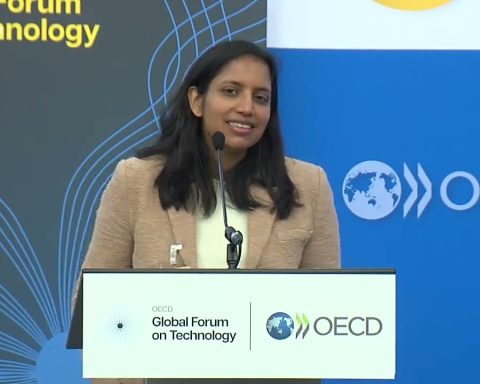


Jennifer Holmgren built her career around a deceptively simple question: what if carbon emissions could become a source of new materials instead of simply something to eliminate? As CEO of LanzaTech, she has spent more than a decade turning that idea into industrial technology, commercial plants, consumer products, and a growing carbon-recycling platform.
Key Takeaways
- Jennifer Holmgren helped move carbon recycling from laboratory research toward commercial industrial applications.
- LanzaTech uses gas fermentation to convert carbon-rich waste gases and other feedstocks into ethanol and chemical building blocks.
- The company’s technology connects heavy industry with markets such as fuels, packaging, apparel, chemicals, and sustainable aviation fuel.
- Holmgren’s career demonstrates how hard-tech innovation often requires scientific expertise, industrial partnerships, patient capital, and commercial persistence.
- LanzaTech’s next challenge is proving that carbon recycling can scale profitably while navigating certification, project financing, feedstock availability, and long development timelines.
The Innovation Starts With a Different View of Carbon
For decades, industrial carbon has largely been treated as a problem to contain. Factories emit carbon-rich gases, governments regulate them, and companies invest in technologies designed to reduce or capture emissions.
The work of Jennifer Holmgren begins from a different premise: some of that carbon can become a feedstock.
LanzaTech‘s technology uses microorganisms and gas fermentation to convert carbon-rich gases into ethanol. That ethanol can then become a fuel or an intermediate for other products. In practical terms, the process creates a bridge between industries that generate carbon and industries that need carbon-based materials.
That distinction matters. The goal is not simply to capture carbon and store it. It is to keep some carbon in circulation by turning it into something that has economic value.
LanzaTech describes this as a circular carbon model. The company’s current platform can process industrial emissions, gasified waste, and carbon dioxide into recycled-carbon ethanol, which can then move into fuels and chemical applications.
The concept sounds straightforward when explained this way. Making it work at industrial scale is considerably harder.
A Chemist Who Learned to Commercialize Technology
Holmgren’s background sits at the intersection of science, engineering, and business.
Born in Colombia, she moved to the United States with her family as a child. She studied chemistry at Harvey Mudd College before earning a Ph.D. in chemistry from the University of Illinois Urbana-Champaign in 1986. She later completed an MBA at the University of Chicago.
Her early career took her to UOP, later part of Honeywell, where she spent roughly two decades working on technologies involving fuels, chemicals, materials, and renewable energy.
That period was important because it exposed Holmgren to a reality that is sometimes overlooked in discussions about scientific innovation: discovering something is only the beginning.
A technology needs engineering. It needs customers. It needs manufacturing partners. It needs financing. It needs regulatory approval and, eventually, a market willing to pay for the resulting product.
At UOP, Holmgren moved into increasingly senior roles and eventually became a leader of its renewable energy and chemicals activities. She was involved in the development and commercialization of alternative-fuel technologies, including pathways that helped demonstrate the potential of renewable aviation fuels.
The experience gave her something that would later become central to LanzaTech: an understanding of how a scientific idea moves through the long and complicated journey toward industrial adoption.
Betting on a Microbe
Holmgren joined LanzaTech at a very different stage of its development.
The company had originated in New Zealand around the work of co-founder Sean Simpson, whose research explored whether microorganisms could consume gases generated by industrial processes and convert them into useful chemicals.
For a scientist and industrial executive with Holmgren’s background, the proposition was unusual but compelling.
Instead of asking how society could stop producing every carbon-containing waste stream, LanzaTech was asking whether biology could help transform those streams into useful products.
That required a major shift in mindset.
Industrial facilities were no longer simply sources of emissions. They could become sources of raw materials.
Under Holmgren’s leadership, LanzaTech pursued partnerships with steel producers, refineries, chemical companies, governments, and consumer brands. Its technology eventually moved beyond demonstrations toward commercial plants.
By 2026, LanzaTech reported six commercial facilities operating globally, with total production capacity across the fleet of approximately 150 million gallons per year.
That is an important innovation milestone because it changes the conversation from whether the underlying science works to whether the technology can be replicated across different industrial environments.
From Smokestacks to Everyday Products
One of the most interesting aspects of Holmgren’s innovation story is that the final products do not necessarily look like climate technology.
Carbon-recycled ethanol can become fuel, but it can also serve as a chemical building block.
LanzaTech has worked with companies in consumer products, apparel, packaging, personal care, and other sectors. Its corporate history includes partnerships involving companies such as Unilever, Coty, and Zara.
That creates a different kind of innovation narrative.
The consumer does not necessarily need to change the way a product works. A jacket still needs to function as a jacket. Packaging still needs to protect its contents. Cleaning products still need to clean.
The potential change happens upstream.
Instead of relying exclusively on newly extracted fossil carbon as the source of chemical building blocks, manufacturers can potentially incorporate carbon that has already been emitted or recovered from waste streams.
That is the commercial logic behind Holmgren’s approach: environmental innovation becomes easier to scale when it can fit into existing products and supply chains.
Aviation Became a Major Test Case
Aviation illustrates both the promise and difficulty of this model.
Airlines cannot simply replace conventional jet fuel with electricity across the existing long-haul aviation system. Sustainable aviation fuel therefore represents one of the major areas where alternative carbon pathways are being developed.
LanzaTech’s technology provides ethanol from recycled carbon. LanzaJet, which was spun out as a separate company, developed technology to convert ethanol into sustainable aviation fuel through an alcohol-to-jet process.
The pathway reached a major demonstration milestone in 2018, when Virgin Atlantic operated a transatlantic flight using fuel derived partly through LanzaTech’s recycled-carbon technology.
LanzaJet subsequently developed the Freedom Pines Fuels facility in Georgia, which became the world’s first commercial-scale plant designed to produce jet fuel from ethanol.
The significance of this development goes beyond one facility.
It demonstrates how an innovation can become a chain rather than a single technology: carbon feedstock becomes ethanol, ethanol becomes jet fuel, and the resulting fuel enters an established aviation system.
That same logic can potentially be applied to other fuels and chemical products.
The Hard Part Is No Longer Just the Science
Holmgren’s story is also useful because it reveals the less glamorous side of climate innovation.
A laboratory breakthrough can happen relatively quickly. A commercial plant can take years.
Industrial facilities require engineering, permitting, financing, construction, feedstock agreements, customers, certification, and reliable operations. The economics must work not just in a demonstration but over the life of a project.
LanzaTech’s recent strategy reflects that reality.
In 2026, the company said it was reducing costs and moving from a more R&D-led model toward commercial project deployment. Its second-quarter results showed operating expenses falling substantially year over year and adjusted EBITDA improving, although the company still reported a negative adjusted EBITDA.
The quarter also produced a large reported net income figure, but LanzaTech said that result was primarily driven by a non-cash unrealized gain related to its investment in Beijing Shougang LanzaTech rather than by underlying operating profitability.
That distinction is important.
The innovation story should not be confused with a claim that the business has already reached mature profitability. LanzaTech remains in the process of proving that its technology platform can produce durable commercial economics at scale.
Scaling Changes the Business Model
One of the more revealing developments under Holmgren is LanzaTech’s changing relationship with its projects.
The company historically emphasized technology development and licensing. More recently, management has described a shift toward owning and operating projects alongside technology deployment.
That is a significant strategic change.
Licensing can allow a technology company to scale without funding every facility itself, but it also limits the amount of economics captured from successful projects. Owning or operating projects can create greater exposure to revenue and long-term value, but it also requires more capital and introduces additional execution risk.
LanzaTech’s 2026 announcements show this transition taking place alongside new sources of capital and project partnerships.
The Beijing Shougang LanzaTech joint venture, for example, completed an initial public offering on the Hong Kong Stock Exchange in June 2026, raising approximately $75 million at an implied market capitalization of roughly $750 million at the offering price. LanzaTech retained an approximately 8.38% stake after the listing.
Meanwhile, the company has continued developing projects in Europe and elsewhere. In May 2026, LanzaTech selected Ghent, Belgium, as the site for a proposed commercial-scale alcohol-to-jet facility targeting 79,000 tonnes of SAF and 9,000 tonnes of renewable diesel annually.
These developments illustrate an important principle in hard-tech innovation: eventually, the technology has to become infrastructure.
Carbon Recycling Has Real Constraints
The circular-carbon concept is powerful, but it is not limitless.
The environmental benefit of any recycled-carbon fuel depends on the source of the carbon, the energy used in processing, transportation, the resulting product, and the methodology used to calculate lifecycle emissions.
There is also a paradox at the heart of industrial carbon recycling. Some feedstocks exist because heavy industry continues to produce emissions. A carbon-recycling business therefore needs to create value from available emissions without turning the continued existence of those emissions into its only source of growth.
Certification is another important piece.
LanzaTech has been pursuing certification for recycled-carbon fuels in European markets, including ISCC EU certification. Such standards can determine whether a product qualifies for particular regulated or mandated markets.
Then there is capital.
Large-scale fuel and chemical facilities can require hundreds of millions of dollars. A technology can be technically viable and still struggle if investors, customers, policymakers, and project developers cannot align around financing and long-term offtake agreements.
Holmgren’s challenge is therefore no longer simply proving that microorganisms can transform waste gases.
It is proving that the entire industrial system around those microorganisms can work.
The Broader Innovation Lesson
Holmgren’s career offers a useful lesson for innovators working on technologies that sit between science and infrastructure.
The breakthrough is rarely one invention.
It is an ecosystem.
LanzaTech requires biology, chemical engineering, industrial facilities, feedstock suppliers, project financiers, regulators, certification bodies, fuel producers, chemical companies, and consumer brands.
That is why Holmgren’s career is particularly relevant to business innovation. Her contribution has not simply been inventing a new process. It has involved translating scientific possibilities into partnerships, projects, products, and markets.
Her own career reflects that same combination.
She is a trained chemist who moved into industrial research, learned commercialization inside a major corporation, earned an MBA, and eventually took on the challenge of scaling a young technology company.
The result is an innovation strategy built around integration.
Carbon recycling does not have to replace every existing energy or manufacturing system to matter. It can enter the system at specific points where conventional alternatives are difficult, expensive, or technically constrained.
What Comes Next for Jennifer Holmgren and LanzaTech?
The next chapter is less about demonstrating that the technology is possible and more about demonstrating that it can become repeatable infrastructure.
LanzaTech says it now has six commercial plants operating and is pursuing additional projects across fuels and chemicals. Its 2026 strategy also places greater emphasis on commercial deployment, cost discipline, certification, and project economics.
The proposed Ghent SAF facility is one example of the scale being targeted. Other projects and partnerships will determine whether the model can move from a collection of pioneering facilities toward a broader global network.
That makes the next stage of Holmgren’s career particularly interesting.
The first question was whether waste carbon could become something useful.
The next question is whether that concept can become an economically sustainable industrial model.
If it can, the impact could extend well beyond fuel. Carbon recycling could become another source of industrial feedstocks for materials, chemicals, packaging, apparel, and other products currently dependent on fossil carbon.
That is the larger idea behind Holmgren’s work: the future of carbon may not be defined only by how much humanity emits, but also by how intelligently it uses the carbon already above ground.
Conclusion
Jennifer Holmgren’s innovation story is not simply about turning emissions into ethanol. It is about changing the role carbon can play in an industrial economy.
Her career shows how difficult technologies move from scientific possibility to commercial reality: through persistence, partnerships, engineering, financing, certification, and repeated attempts to make the economics work.
LanzaTech has not finished that journey. Its technology has reached commercial plants and real products, but the company still faces the difficult work of scaling projects, improving economics, and proving long-term profitability.
That tension is precisely what makes Holmgren’s story valuable for an innovation-focused audience. The most consequential technologies are rarely finished when the science works. They become innovations when the science can survive contact with the real world.
FAQs
Who is Jennifer Holmgren?
Jennifer Holmgren is a chemist and business executive who serves as CEO of LanzaTech, a company focused on recycling carbon into fuels and chemical products. She previously spent roughly two decades at UOP, part of Honeywell, working on energy and chemical technologies.
What does LanzaTech do?
LanzaTech uses gas fermentation to convert carbon-rich industrial emissions and other feedstocks into ethanol. That ethanol can be used directly as a fuel or converted into sustainable aviation fuel and other chemical products.
Why is Jennifer Holmgren important to carbon recycling?
Holmgren has helped move carbon-recycling technology from research and demonstration toward commercial industrial deployment. Her work has connected the technology to steel producers, fuel companies, chemical manufacturers, consumer brands, and aviation projects.
What is LanzaTech’s connection to sustainable aviation fuel?
LanzaTech produces ethanol from recycled carbon, while LanzaJet has developed an alcohol-to-jet pathway that converts ethanol into sustainable aviation fuel. The two companies have collaborated on projects designed to connect recycled-carbon feedstocks with aviation fuel production.
What challenges does LanzaTech still face?
Scaling carbon-recycling technology requires significant capital, reliable feedstocks, certification, long-term customers, and competitive project economics. LanzaTech has made progress with commercial plants and project development, but its recent financial results show that the company is still working toward sustainable operating profitability.
Sources: